
Why Growth Feels Harder Than It Should, Even When Nothing Is Obviously Broken


Growth friction is the drag created when demand, conversion, systems and accountability do not work together. A company may still win customers and grow revenue, yet every result requires more manual effort, founder involvement and last-minute intervention.
Growth can therefore feel harder even when nothing appears completely broken. The problem is often several manageable weaknesses combining into a commercial system that cannot produce predictable momentum.
McKinsey notes that growth execution requires data, rigorous tracking and operating systems. Most businesses do not manage growth with that discipline.
Growth can slow without a single obvious failure
Leadership teams naturally search for one explanation. Marketing needs more leads. Sales needs better training. The CRM needs replacing. The company needs more people.
Any may be true. But the visible symptom is not always the root constraint. Weak pipelines can begin with inconsistent demand, but it can also come from poor follow-up or unreliable data. Missed revenue can look like a sales problem when opportunities are disappearing between marketing, CRM and ownership.
When several areas are only partially effective, no department appears responsible. The company remains busy while growth becomes increasingly expensive to produce.
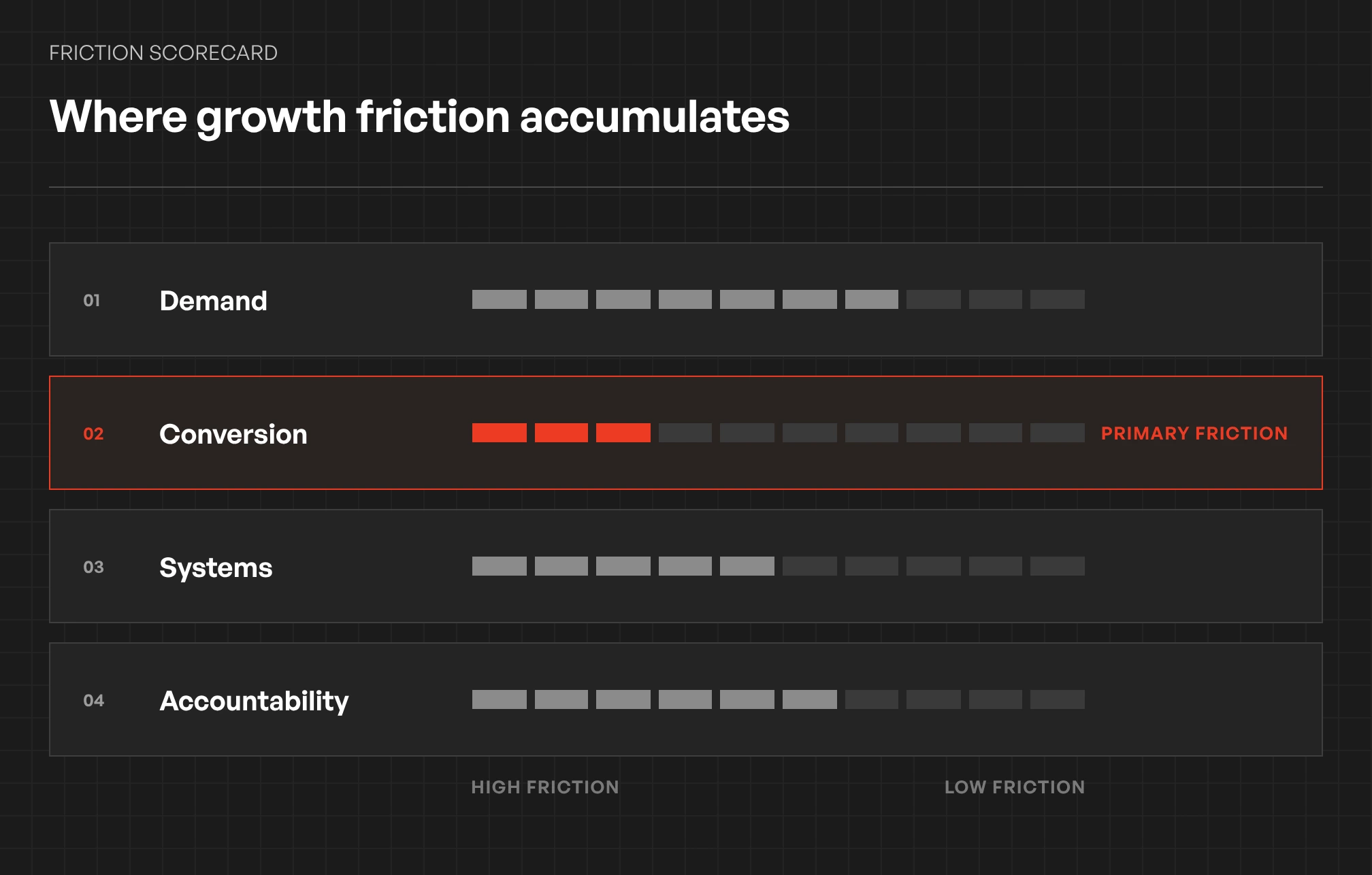
The four places commercial friction accumulates
Demand friction appears when qualified opportunities depend heavily on referrals, relationships or one unpredictable channel. The company may have good months, but leadership cannot confidently explain where the next quarter’s pipeline will come from.
Conversion friction appears when opportunities lack a reliable next step. Follow-up depends on individual habits, quiet deals remain unnoticed and forecasts are based more on instinct than observable buyer movement.
Systems friction appears when the CRM does not reflect how work actually happens. Information is entered before meetings, maintained in separate spreadsheets or trapped in inboxes. Leadership sees numbers without knowing whether the data can support a decision.
Accountability friction appears when performance is discussed without changing behavior. Teams review missed targets, but causes are not translated into actions, owners and follow-up. The same issue returns at the next meeting.
Each weakness may look survivable alone. Together, they create a business that relies on memory, effort and rescue rather than a connected growth system.
Why adding more activity can increase the problem
More activity does not automatically remove friction. More campaigns can send leads into inconsistent follow-up. More software can create another disconnected data source. More hiring can add handoffs before ownership is clear. More reporting can produce dashboards without improving decisions.
Salesforce’s 2026 State of Sales research found that disconnected systems are slowing AI initiatives and that high-performing teams emphasize data hygiene. The broader lesson: technology creates leverage only when information and workflow are reliable.
Before adding another tactic, leadership should ask whether the commercial system can absorb and convert the activity.
Measure before deciding what to fix
A useful diagnosis does not produce a long improvement list. It identifies the primary friction, its dependencies and the first action most likely to improve performance.
Use the Growth Friction Scorecard or start with four questions:
- Where do qualified opportunities consistently come from?
- What happens when an active opportunity goes quiet?
- Can leadership trust the CRM and pipeline forecast?
- When a result is missed, what decision and action follow?
The answers reveal whether the next investment should create demand, improve conversion, strengthen systems or establish accountability. They protect the company from solving the most visible problem instead of the most important one.
Find what is slowing your growth
The Forward Thinkers Growth Friction Scorecard evaluates demand, conversion, systems and accountability in two minutes. You receive a snapshot of your scores and primary friction before being asked for any information.
Take the Growth Friction Scorecard and identify where your commercial system needs attention next.
Frequently Asked Questions
What is growth friction?
Growth friction is the operational drag created when demand, conversion, systems or accountability are inconsistent or disconnected.
Does a low score mean the business is failing?
No. It indicates where growth depends on unnecessary effort, individual intervention or unreliable processes.
What should a company do after identifying its primary friction?
Choose one measurable outcome, assign an accountable owner and address the highest-impact constraint before adding campaigns, tools or headcount.
What this unlocks next
Once you know where friction is concentrated, the next step is turning the diagnosis into a focused 90-day action plan with an owner, measures and a review cadence.
Get the next Forward Thinkers insight
Subscribe for practical guidance on brand, growth, AI, customer reach and execution. Explore Forward Thinkers Insights.
Sign up for our newsletter
Related posts