
Management Cadence: How Leaders Turn Demanded Outcomes Into Measured Results


Execution breaks when meetings replace management
Many leadership teams meet often and manage inconsistently. Calendars are full, updates are frequent, and task lists keep growing. Yet priorities shift, ownership blurs, decisions are deferred, and the same friction appears month after month. The organization has communication, but it does not have a disciplined cadence that converts a demanded outcome into measured movement.
A management cadence is not another meeting format. It is an operating loop. Leadership defines the outcome, selects the initiatives most likely to create it, assigns accountable owners, measures progress, reviews variance and friction, makes decisions, and updates the system for the next cycle. The meeting is one moment inside that loop.
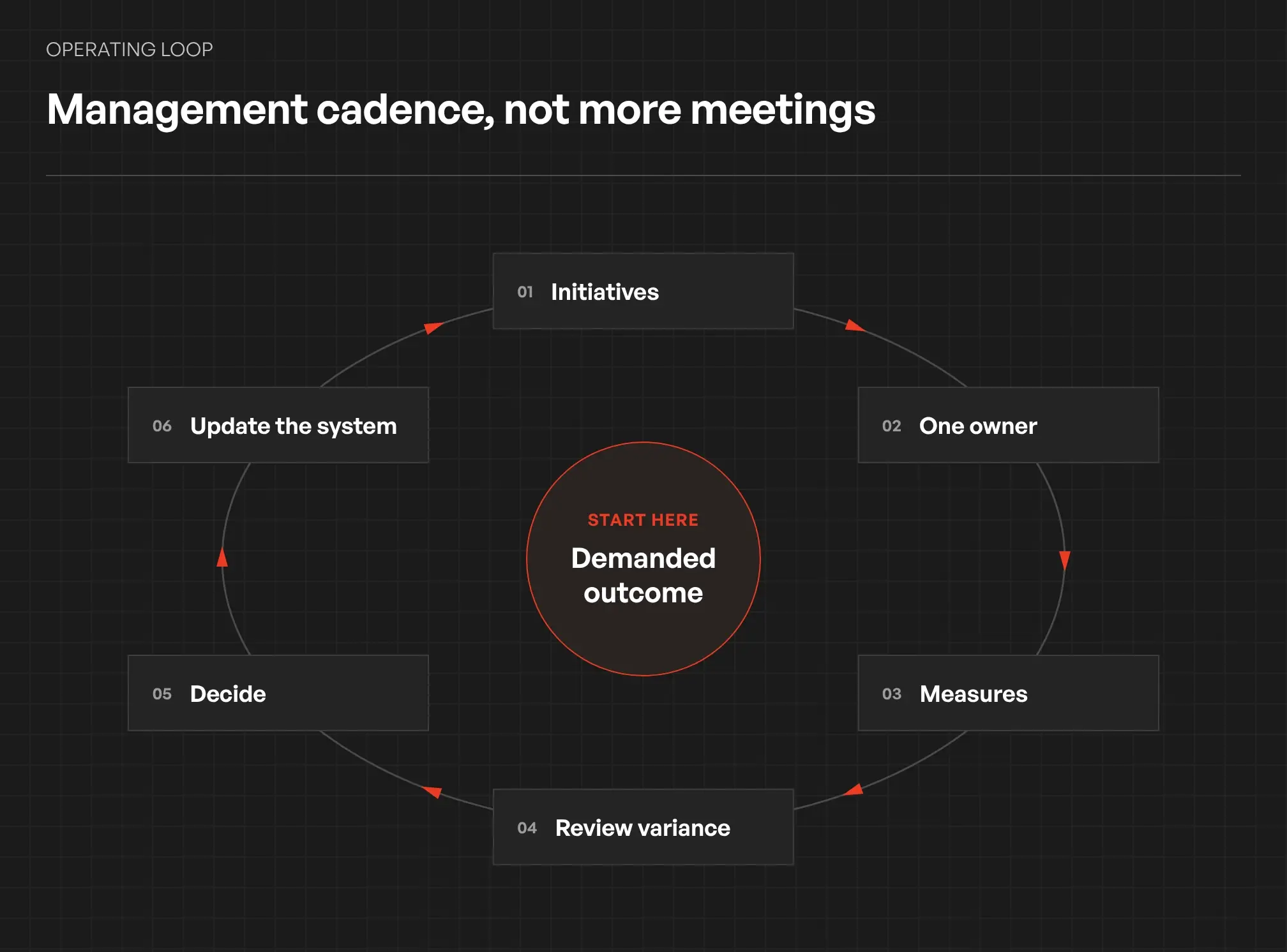
Begin with a demanded outcome
A demanded outcome is a business result stated with enough specificity that leadership can determine whether it moved. It may be qualified pipeline, conversion, margin, cycle time, customer retention, AI workflow performance, website inquiries, or a completed operating milestone. It should include a time frame and a clear owner.
The word demanded matters because it separates preference from commitment. Leadership may want many improvements. The cadence requires a smaller set of outcomes the business is willing to organize resources and decisions around. Without that constraint, every idea becomes a priority and management becomes reactive.
Translate the outcome into initiatives, not tasks
An initiative is a coordinated body of work designed to change the outcome. Tasks are the actions inside it. Confusing the two causes teams to celebrate completion without confirming impact. Publishing a website, configuring a CRM, producing assets, or launching an AI pilot may be necessary, but none is automatically the business result.
Each initiative should state the theory of change. If we improve the market story and buyer path, qualified conversion should increase. If we define stages, SLAs, and automated follow up, lead decay should decrease. If we redesign a workflow and govern the source environment, cycle time should fall without unacceptable quality loss. The theory can then be tested against measures.
Assign one accountable owner
Cross functional work still needs one accountable owner. Several people may contribute, but one person is responsible for moving the initiative, surfacing risk, requesting decisions, and reporting evidence. Shared ownership often means no one has authority to resolve tradeoffs or responsibility for the final result.
Accountability must be matched with decision rights, information, capacity, and sponsorship. Assigning a name without giving the owner the ability to act creates performative accountability. Leaders should make dependencies and escalation routes explicit so the owner can move the work rather than wait for informal permission.
Use leading and lagging measures together
Lagging measures confirm the business result: revenue, margin, conversion, retention, cycle time, customer satisfaction, or cost. Leading measures show whether the operating changes likely to influence the result are occurring. A website initiative may track qualified CTA engagement and decision page progression before revenue closes. A sales initiative may track response SLA and stage movement before bookings.
The measures should be limited and decisions useful. Dashboards often grow until no one knows what requires action. Every metric in the cadence should answer one of three questions: Is the outcome moving? Is the initiative being adopted? Is a risk or constraint emerging that requires a decision.
Review variance and friction, not just status
A status update explains what happened. Management review asks why the result differs from the plan and what decision follows. Variance may come from an incorrect assumption, weak adoption, a missing dependency, insufficient capacity, data quality, customer behavior, or a process that does not work as designed. The cadence should make those causes visible.
Friction should be categorized. Some friction belongs to the initiative and can be resolved by the owner. Some are cross functional and need leadership intervention. Some reveal a deeper system constraint that changes the plan. Some are noise that should not distract from the demanded outcome. The meeting should focus on exceptions and decisions, not every completed task.
- Outcome variance: the result is not moving at the expected rate.
- Execution variance: planned actions or adoption are not occurring.
- Dependency friction: another team, system, decision, or resource blocks progress.
- Quality risk: speed or volume is improving while accuracy, trust, or customer experience declines.
- Assumption failure: evidence shows the original theory of change was incomplete or wrong.
- Decision requirement: leadership must choose, stop, fund, sequence, or change ownership.
Make decisions visible and time bound
A management cadence loses credibility when teams repeatedly surface issues and leadership defers action. Decisions should be recorded with an owner, date, rationale, and affected initiative. When information is incomplete, define what evidence is required and when the decision will return. Indefinite ambiguity is itself a decision that consumes capacity.
Visible decisions also protect organizational memory. Teams can understand why a priority changed, why a workflow was stopped, why a risk was accepted, or why resources moved. This reduces repeated debate and gives AI-enabled knowledge systems better source material for future execution.
Convert learning into the operating system
Continuous improvement requires more than discussing lessons. When the team learns that a stage definition is weak, a source is outdated, an asset does not answer the objection, or an AI workflow produces a repeated exception, the relevant SOP, automation, page, training, or governance rule should be updated. Otherwise the organization relies on memory and repeats the issue.
This is where management cadence becomes a system rather than a meeting. Decisions change the way work is performed. Updated standards shape the next cycle. The organization becomes faster not because people rush, but because the operating model absorbs learning.
Use weekly, monthly, and quarterly rhythms for different decisions
Weekly cadence should focus on current outcome movement, initiative exceptions, dependencies, and decisions that cannot wait. Monthly cadence should review trends, resource allocation, cross functional performance, customer and pipeline signals, workflow quality, and whether the theory of change remains valid. Quarterly cadence should reset demanded outcomes, sequence major initiatives, and retire work that no longer matters.
The rhythms should connect. Weekly information should roll into monthly learning. Monthly learning should inform quarterly choices. Different meetings should not create different versions of the truth. One operating view should show the outcome, initiatives, owners, measures, friction, decisions, and next cycle.
AI can support cadence without replacing leadership
AI can summarize progress, detect missing updates, classify recurring friction, prepare variance analysis, retrieve prior decisions, and draft follow up actions. Agents can monitor SLA breaches, stale initiatives, unresolved exceptions, and inconsistent data. These uses reduce administrative work and improve visibility.
Leadership still owns prioritization, tradeoffs, accountability, risk, and decisions. An automated dashboard cannot decide which customer promise matters, whether a strategic assumption should change, or how to balance speed with trust. AI should improve the quality and timeliness of management information, not become a substitute for management.
The cadence closes the Commercial Growth Operating System
Market stories create relevance. Digital assets and proof help customers decide. The Integrated Sales System creates owned movement. Human led AI workflows improve execution. Management cadence connects those disciplines to demanded outcomes and measured results. Without the cadence, the system can fragment back into projects and departmental activity.
This is the principle that carries the Forward Thinkers brand into the future. Growth is not a collection of tactics. It is a managed commercial system that leadership can diagnose, build, connect, activate, measure, and improve. The cadence is how the business keeps that system alive after the launch, workshop, or implementation ends.
A disciplined rhythm creates strategic capacity
When management routines work, leaders spend less time reconstructing status and more time making decisions. Owners know what matters, teams understand how their work connects to the outcome, and repeated friction becomes visible early. The company can stop low value activity with greater confidence and redirect capacity toward the highest impact constraint.
The result is not only better accountability. It is a better learning speed. A company that can set an outcome, test an initiative, observe the result, and update its operating model faster than competitors builds a durable advantage. That is the purpose of management cadence.
Cadence should protect focus during periods of change
Growth, acquisition, leadership changes, system implementations, and AI adoption all increase the number of urgent requests. A disciplined cadence gives leadership a way to absorb new information without allowing every issue to reset the operating agenda. New work is evaluated against the demanded outcome, current constraints, capacity, and consequence.
This does not make the company inflexible. It creates a controlled way to change. The team can add, stop, or resequence an initiative through an explicit decision rather than through silent drift. Focus becomes a management capability instead of a temporary act of will.
Frequently asked questions
What is a management cadence?
It is the recurring operating rhythm that connects demanded outcomes, initiatives, accountable owners, measures, exception review, decisions, and continuous improvement.
How is a management cadence different from a status meeting?
A status meeting reports activity. A management cadence reviews outcome movement, variance, friction, decisions, and changes required in the operating system.
What should be reviewed weekly?
Review outcome movement, initiative exceptions, dependencies, SLA or quality issues, decisions, and ownership for the next action.
How can AI support management cadence?
AI can prepare summaries, retrieve decisions, monitor exceptions, classify friction, and highlight missing information while leaders retain accountability for priorities and decisions.
Turn Leadership Priorities Into Measured Progress
Build a management rhythm that keeps outcomes, decisions, accountability, and learning visible without turning every meeting into a status review. Explore Business Strategy.
Sign up for our newsletter
Related posts