
How to Choose the First AI Workflow: Business Impact, Readiness, Work at Risk, and Governance


The first workflow should build capability, not just excitement
Leaders often begin AI selection with a brainstorm. Teams list dozens of use cases, choose the most visible idea, and build a pilot that is interesting but disconnected from an operating priority. The pilot may demonstrate that the technology works while teaching the organization very little about governance, integration, adoption, or measurable business value.
The first workflow should do more. It should improve a real outcome and help the company develop the disciplines required for future workflows. That means the use case must be valuable enough to matter, bounded enough to govern, repeatable enough to measure, and safe enough to learn from.
Start with business impact, not technical novelty
Business impact should be defined in measurable terms: time recovered, cycle time reduced, capacity increased, conversion improved, cost reduced, customer response accelerated, quality stabilized, or risk controlled. A use case that produces an impressive demonstration but does not alter a meaningful business measure should not lead the roadmap.
Estimate both direct and strategic impact. Direct impact may be hours, cost, throughput, or revenue. Strategic impact may include faster learning, stronger customer experience, reduced dependency on one expert, or improved visibility. The estimate does not need false precision, but it should be credible enough to compare opportunities.
Assess implementation readiness honestly
A high value workflow may not be ready. Readiness depends on process stability, source quality, system access, role clarity, decision rules, technical integration, and management sponsorship. If the work is performed differently by every employee, the source data is unreliable, or no one owns the outcome, automation will expose those weaknesses rather than resolve them.
Readiness is not a reason to abandon a valuable use case. It tells leadership what must be prepared. Some workflows should enter a prepare and govern lane while the company standardizes SOPs, cleans data, resolves permissions, and defines measures. The roadmap should distinguish build now from prepare next.
Make work at risk visible
Work at risk is the volume of employee time, customer experience, revenue, or operating dependency affected by the workflow. A large bubble may represent thousands of repetitive hours, a high value customer touchpoint, or a process on which several teams depend. This dimension matters because a workflow can have moderate per item value and still create major enterprise impact through volume.
Work at risk also affects pilot design. A high volume, customer-facing workflow may require a narrower initial scope and stronger fallback. A lower consequence internal workflow may allow faster iteration. Bubble size should influence governance, testing, and rollout, not only priority.
Match governance to consequence
Governance requirements should be visible before selection. Consider data sensitivity, customer impact, financial consequence, policy interpretation, regulatory exposure, brand claims, and the reversibility of an error. A workflow touching public content or customer commitments may require stronger source validation and human approval than an internal classification task. NIST’s AI Risk Management Framework offers a useful foundation for mapping, measuring, and managing those risks in context.
The purpose is not to avoid consequential work forever. It is to understand the controls and preparation required. A high impact workflow with high governance needs may still be the right strategic priority, but it may belong in a phased program rather than a rapid first build.
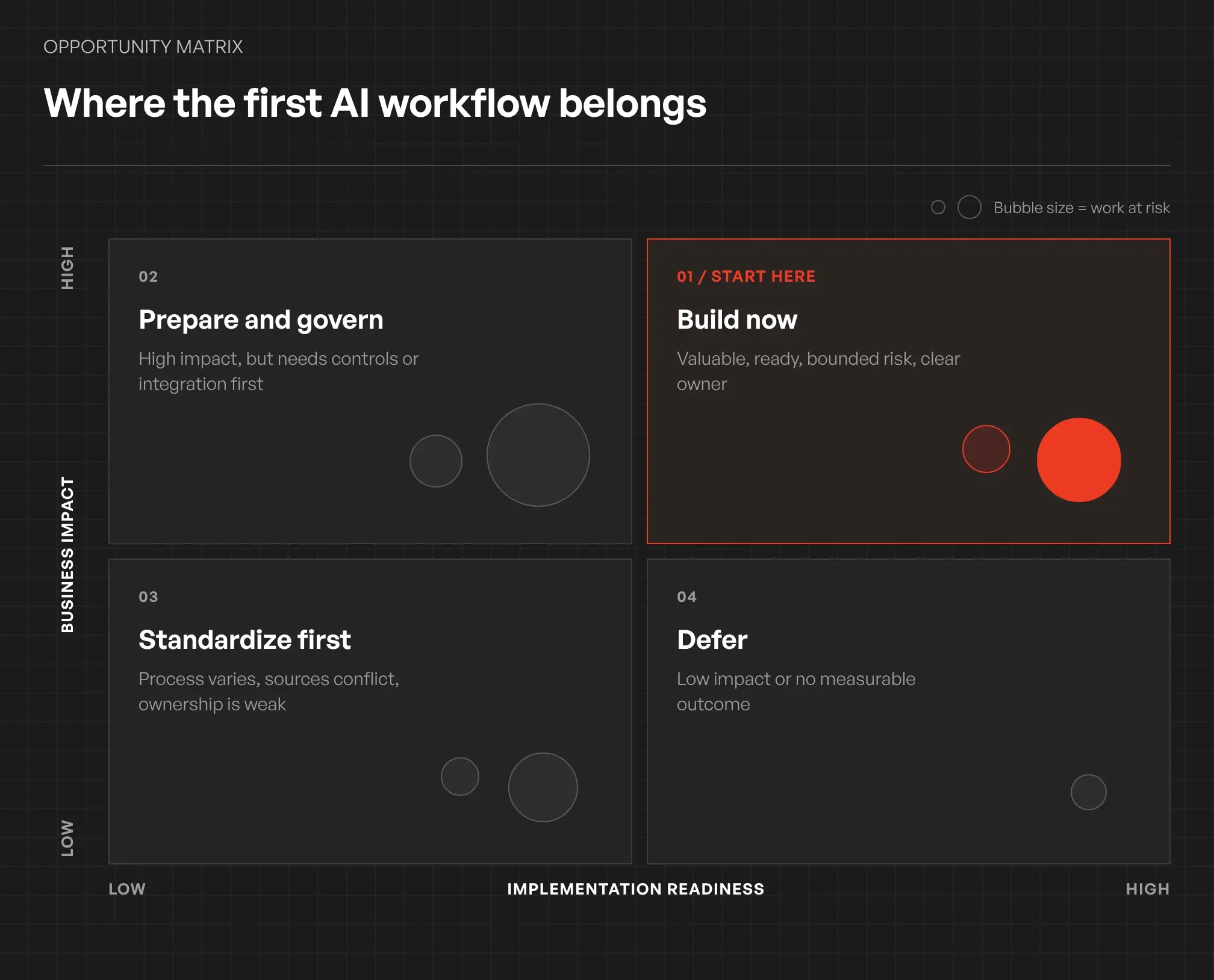
Use a four quadrant opportunity matrix
A practical matrix uses business impact on one axis and implementation readiness on the other. Bubble size represents work at risk. Ring or category indicates governance requirement. This makes the decision logic visible to executives, operators, and technical teams without reducing the conversation to a single score.
The four actions are Build Now, Prepare and Govern, Standardize First, and Defer. Build Now contains valuable, ready, measurable workflows. Prepare and Govern contains high impact opportunities that need controls or infrastructure. Standardize First contains work that is too inconsistent to automate responsibly. Defer contains low value or poorly timed ideas that should not consume capacity.
- Build Now: high impact, high readiness, bounded risk, clear owner, usable data, measurable result.
- Prepare and Govern: high impact, lower readiness, significant controls or integration required.
- Standardize First: process varies, sources conflict, ownership is weak, or the work is not documented.
- Defer: low impact, weak strategic fit, no measurable outcome, or better solved through a simpler process change.
Favor recurring and observable work
The first workflow should occur often enough to generate learning and evidence. A process completed twice a year may be valuable, but it will take too long to evaluate. Recurring work creates more test cases, faster feedback, and a clearer baseline. Observable work also makes adoption easier because teams can see where time and quality change.
Good early candidates often include request classification, document intake, meeting to action conversion, structured research, customer interaction summarization, knowledge retrieval, content operations, follow up preparation, and workflow monitoring. The correct choice depends on the company, but the pattern is stable: repeated work, clear inputs, defined output, and a measurable next action.
Choose a workflow with reversible actions and safe fallback
A reversible workflow allows the company to learn without exposing the business to disproportionate damage. The AI may prepare a recommendation for human approval, draft a response, classify a request, or update a sandbox before it acts independently in production. This creates evidence while preserving control.
Safe fallback means the work can route to a person when confidence is low, data is missing, or a rule is triggered. The pilot should not depend on the AI completing every case. It should prove that routine cases can move faster while exceptions remain owned and visible.
Define pilot gates before building
A pilot needs explicit entry, evaluation, and scale criteria. Entry criteria include approved sources, owner, baseline, test cases, access, and defined scope. Evaluation criteria include quality, cycle time, human effort, exception rate, user adoption, and business impact. Scale criteria define what evidence is required before the workflow expands to more users, data, actions, or customers.
Predefined gates prevent enthusiasm from outrunning evidence. They also make it easier to stop or redesign a workflow without treating the pilot as a failure. A useful pilot creates a decision, even when the decision is to standardize the process first or defer automation.
Build the roadmap from what the first workflow teaches
The first implementation will reveal more than model performance. It will show whether source ownership is strong, whether teams follow SOPs, whether data boundaries are clear, whether integrations are reliable, whether managers review exceptions, and whether employees understand the new role design. Those lessons should shape the next workflow and the broader governance model.
A capability roadmap compounds. Reusable connectors, source libraries, evaluation methods, access rules, approval patterns, and measurement standards reduce the effort required for future workflows. The first workflow should therefore be selected partly for the operating capability it helps the organization build.
Prioritization is a leadership decision
Technology teams can estimate feasibility and risk. Functional owners understand the work and exceptions. Finance can test value. Employees can reveal actual process behavior. Leadership must integrate those views and choose where the organization will learn. No single department should select the first workflow in isolation.
The best starting point is not always the easiest or the largest. It is the workflow that balances value, readiness, work at risk, governance, and learning. That choice creates a credible path from experimentation to governed scale.
Use the first workflow to establish a reusable decision record
Document why the workflow was selected, which alternatives were deferred, what assumptions supported the value estimate, what controls were required, and what scale gates were approved. This decision record becomes a reference for later prioritization and helps leadership distinguish learning from hindsight bias.
When the pilot ends, compare the original assumptions with actual results. The difference improves the organization’s ability to estimate value, readiness, adoption, and risk on future workflows. The roadmap becomes more intelligent because selection is grounded in accumulated evidence rather than a new brainstorm each quarter.
Include the people and change requirement in prioritization
Readiness is not only data and technology. A workflow may be technically feasible but poorly timed if the team is already absorbing a major system change, lacks a credible owner, or does not understand how roles will change. Include training demand, manager capacity, employee trust, and the availability of subject matter experts in the readiness assessment.
This prevents the roadmap from treating adoption as a final communication task. The people who perform and manage the work are part of the design. Their knowledge improves the workflow, and their ability to use it determines whether the projected value becomes real.
Frequently asked questions
What makes a good first AI workflow?
It is valuable, recurring, bounded, measurable, supported by usable data, owned by a business leader, and safe enough to learn from.
How should AI opportunities be prioritized?
Compare business impact, readiness, work at risk, governance requirements, process stability, data quality, reversibility, and measurement.
What if the highest value workflow is not ready?
Place it in a prepare and govern lane, then standardize the process, clean sources, resolve access, define ownership, and build controls before automation.
What should a pilot prove?
It should prove task quality, workflow improvement, safe exception handling, adoption, integration, and measurable business value against a baseline.
Sources & Further Reading
Choose an AI Workflow Worth Scaling
Evaluate business impact, readiness, work at risk, governance, and learning value before committing resources to the first build. Start an AI Workflow Assessment.
Sign up for our newsletter
Related posts