
Digital Assets as Decision Infrastructure: Build Fewer Assets That Do More Commercial Work


The problem is rarely a shortage of content
Most growing companies already have more files than they can manage. They have presentations, one page documents, website pages, social posts, campaign creative, customer stories, email templates, proposals, videos, and old versions stored across drives and inboxes. Yet sales still explains the same issues repeatedly, buyers still ask questions the assets should answer, and leadership still believes the organization needs more content.
The real problem is usually not volume. It is that the assets were created as individual deliverables rather than as a connected decision system. Each item may look acceptable on its own, but the collection does not guide a buyer from relevance to proof, risk reduction, internal consensus, and action. The company keeps producing because no one has defined what each asset is supposed to accomplish.
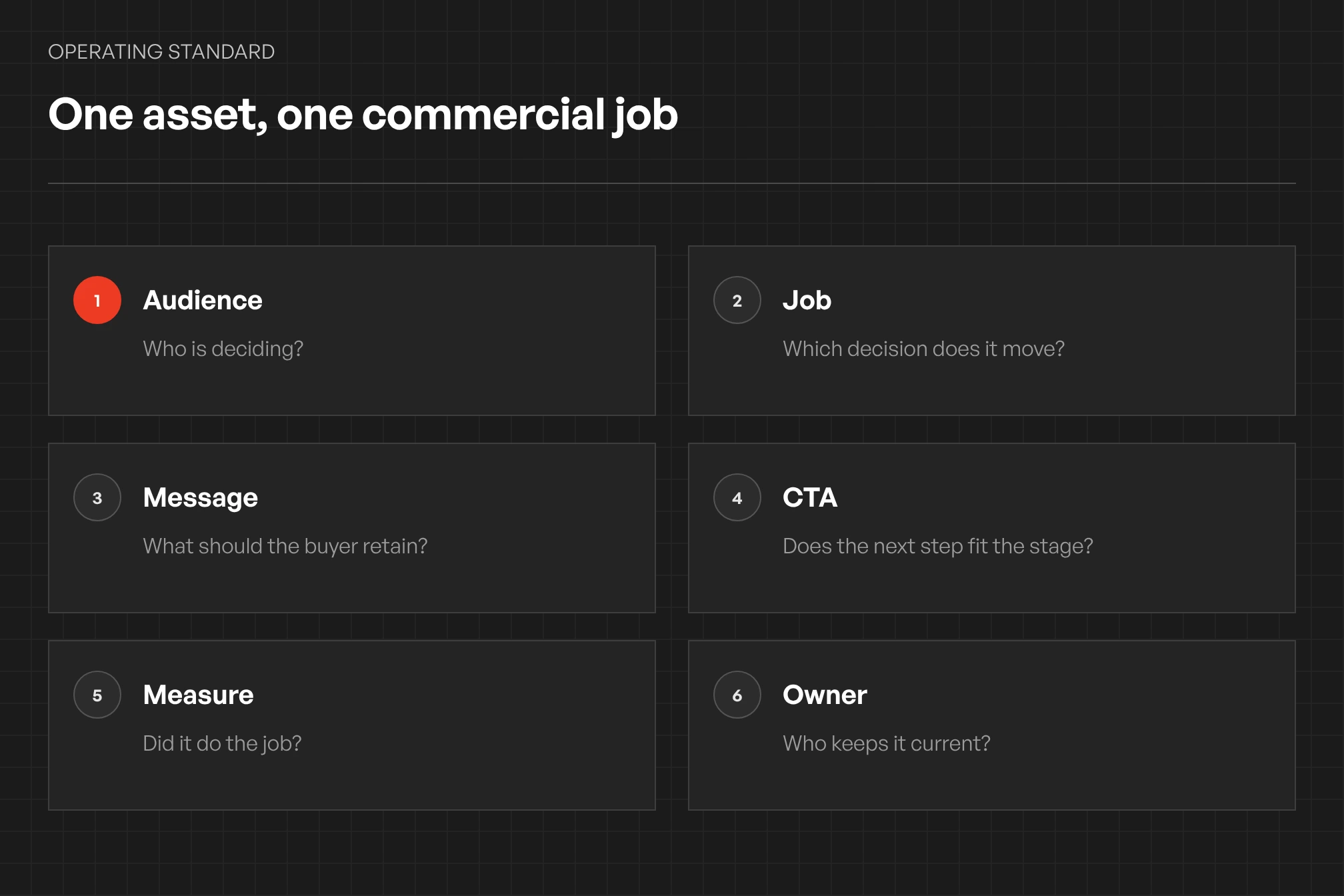
Every asset needs one commercial job
A strong digital asset begins with a precise job. A homepage should establish category, relevance, and the next path. A service page should help the buyer understand the problem, evaluate the approach, review proof, and choose an action. A case study should reduce performance risk. A sales deck should support a live conversation and help the champion build internal consensus. An email should move one audience toward one next decision.
When one asset tries to perform every job, it becomes crowded and vague. When no job is defined, design and copy become subjective. The operating standard should be simple: one primary audience, one decision job, one dominant message, one CTA, and one measure. Supporting content may exist, but it cannot compete with the central purpose.
- Audience: the specific role, company type, maturity, and decision context.
- Job: clarify, prove, reduce risk, support consensus, or advance the next step.
- Message: the one commercial truth the buyer should retain.
- CTA: the next action that fits the buyer stage and level of commitment.
- Measure: the behavior that indicates the asset performed its job.
- Owner: the person responsible for currency, placement, and performance review.
Why assets fail even when the design looks strong
Assets fail for predictable reasons. They are unclear about the problem or audience. They make claims without proof. They change language from one channel to another. They are disconnected from the next page or sales action. They are published without tracking, ownership, or a refresh date. The design may be polished, but the asset does not reduce work for the buyer or the sales team.
This is why a new visual identity alone rarely changes commercial performance. Better aesthetics can improve attention and perceived quality, but they cannot compensate for missing decision logic. The copy must state the outcome. The visual should show the system, comparison, sequence, or proof. The CTA must route the reader into the right next step. The measurement plan must show whether that movement occurred.
Build coordinated packages instead of isolated files
The highest value production model is a coordinated package built around one buyer problem or campaign objective. A website page, proof story, campaign unit, sales enablement asset, and follow up email should share the same market story and evidence. Each format performs a different job, but they reinforce the same decision path. This creates compounding value because the company is not rebuilding strategy for every channel.
Forward Thinkers organizes asset work around five commercial packages: website pages, proof assets, campaign assets, sales enablement, and AI-enabled content systems. The categories are not a menu of file types. They represent the jobs required to help a buyer understand the issue, believe the outcome, reduce internal risk, and move forward. The package should be selected based on the constraint, not based on which format the team wants to produce.
Digital assets should hand demand into sales ownership
Content and design work often end at publication. Commercial work cannot. A buyer who engages with a high intent asset should enter a defined follow up path. The form, campaign source, page context, and expressed interest should move into the CRM. Sales should know what the buyer consumed, what decision the asset addressed, who owns the response, and what proof or next step should follow.
The handoff should be explicit: demand created, buyer engages, lead captured, sales follows up, performance measured. Without that operating link, the company can create attention without learning or revenue movement. The asset system is complete only when the digital interaction connects to ownership and measurement.
Design for hidden buyers and internal sharing
B2B decisions are rarely made by one person. The visible contact may value the offer, but hidden stakeholders evaluate financial risk, operational disruption, technical credibility, procurement requirements, and strategic fit. An effective asset system gives the champion portable evidence that can survive outside the original conversation.
This means case cards, one page summaries, proof visuals, process diagrams, and short videos should make sense when forwarded without a salesperson present. Headlines should carry the conclusion. Results should include context. Visuals should show the operating logic. Confidential work can be anonymized by sector and starting condition while retaining enough specificity to support a serious decision.
Use AI to improve the system, not flood it
AI can accelerate research synthesis, content adaptation, metadata preparation, social extraction, email variants, asset tagging, and performance summarization. It can also help identify redundant files, stale proof, broken internal links, and missing buyer questions. These are high value uses because they improve the operating system around expertise and production.
The risk is using faster generation to create more ungoverned assets. If the source story, approved proof, audience, CTA, and review rules are unclear, automation multiplies inconsistency. The correct sequence is to define the asset job, approved source material, quality criteria, owner, and measurement before automating creation or distribution.
Create an asset inventory that supports decisions
A practical inventory should record more than file name and location. It should include audience, buyer stage, decision job, primary claim, proof source, CTA, owner, publication status, linked service, distribution channels, analytics events, and review date. This gives marketing, sales, design, and leadership one view of what the asset is for and whether it remains usable.
The inventory also exposes gaps and duplication. If several assets answer the same early stage question while no asset supports financial approval, the issue is visible. If three decks make different claims about the same service, the governance problem is visible. If high performing assets have no follow up path, the conversion gap is visible. Inventory becomes intelligence when it informs what to keep, consolidate, refresh, stop, or build next.
Measure movement, reuse, and sales utility
Pageviews and downloads are not enough. Measure whether the asset advanced the buyer. Track CTA clicks, progression to service pages, return visits, case study engagement, form completion, sales use, assisted pipeline, and the frequency with which assets help answer recurring objections. For internal assets, track adoption and whether sales uses the current version.
Reuse is another important measure. A substantial insight that becomes a website page, executive post, campaign sequence, sales follow up, video, and workshop module has created more value than six unrelated pieces. The goal is not to count outputs. It is to increase the commercial return on each verified idea and proof source.
The future belongs to coordinated decision systems
Buyers do not experience a website, deck, email, case study, and salesperson as separate departments. They experience one company. Every asset either reinforces the market story or introduces doubt. Every handoff either creates momentum or forces the buyer to reconstruct the meaning. Coordination is therefore a brand issue, a sales issue, and an operating issue at the same time.
Companies should build fewer assets with greater purpose, stronger evidence, and clearer placement. A disciplined asset system reduces repeated explanation, improves sales consistency, strengthens AI and search visibility, and makes commercial learning easier to capture. That is the difference between content production and decision infrastructure.
Asset governance should include retirement decisions
A mature asset system also decides when an asset should be retired. Old decks, obsolete service language, unsupported claims, and duplicate pages create risk because employees and AI systems may continue using them. Retirement should include archive status, redirects where public URLs change, replacement links, CRM template updates, and communication to internal users.
This discipline protects the market story and reduces search cannibalization. It also makes the source environment safer for AI-enabled content operations because the system can distinguish approved current material from historical reference. Creation without retirement eventually produces clutter faster than value.
Frequently asked questions
What is a digital asset system?
It is a coordinated library of pages, proof stories, campaigns, emails, social content, and sales tools built around buyer decisions, clear CTAs, ownership, tracking, and review dates.
How are digital assets different from content production?
Digital assets are designed to perform a specific commercial job such as clarifying value, proving an outcome, reducing risk, supporting consensus, or advancing the next step.
What should every sales or marketing asset include?
Define the audience, decision job, message, proof, CTA, owner, placement, measurement, and review date.
How should companies measure digital assets?
Measure buyer progression, CTA behavior, assisted pipeline, sales adoption, reuse, and whether the asset reduces repeated explanation or decision friction.
Build Digital Assets Around Buyer Decisions
Create fewer, stronger assets that each have a clear audience, decision job, next action, and role in the customer journey. Explore Digital Transformation.
Sign up for our newsletter
Related posts


