
AI Tools Are Not AI Workflows: The Operating Redesign Required for Real Leverage


Tool adoption can rise while operating leverage stays flat
Many companies now have widespread AI use and very little measurable transformation. Employees summarize meetings, draft emails, research topics, create presentations, and test copilots. Those uses can save time, but they do not automatically change how the business operates. Work still enters through the same channels, decisions still depend on the same bottlenecks, systems remain disconnected, and management cannot consistently explain what has improved.
The distinction matters because leaders can mistake activity for capability. A growing number of prompts, licenses, and generated outputs may look like adoption, yet the organization may still be babysitting tools and manually moving work between people and systems. The commercial objective is not more AI use. It is better workflow performance.
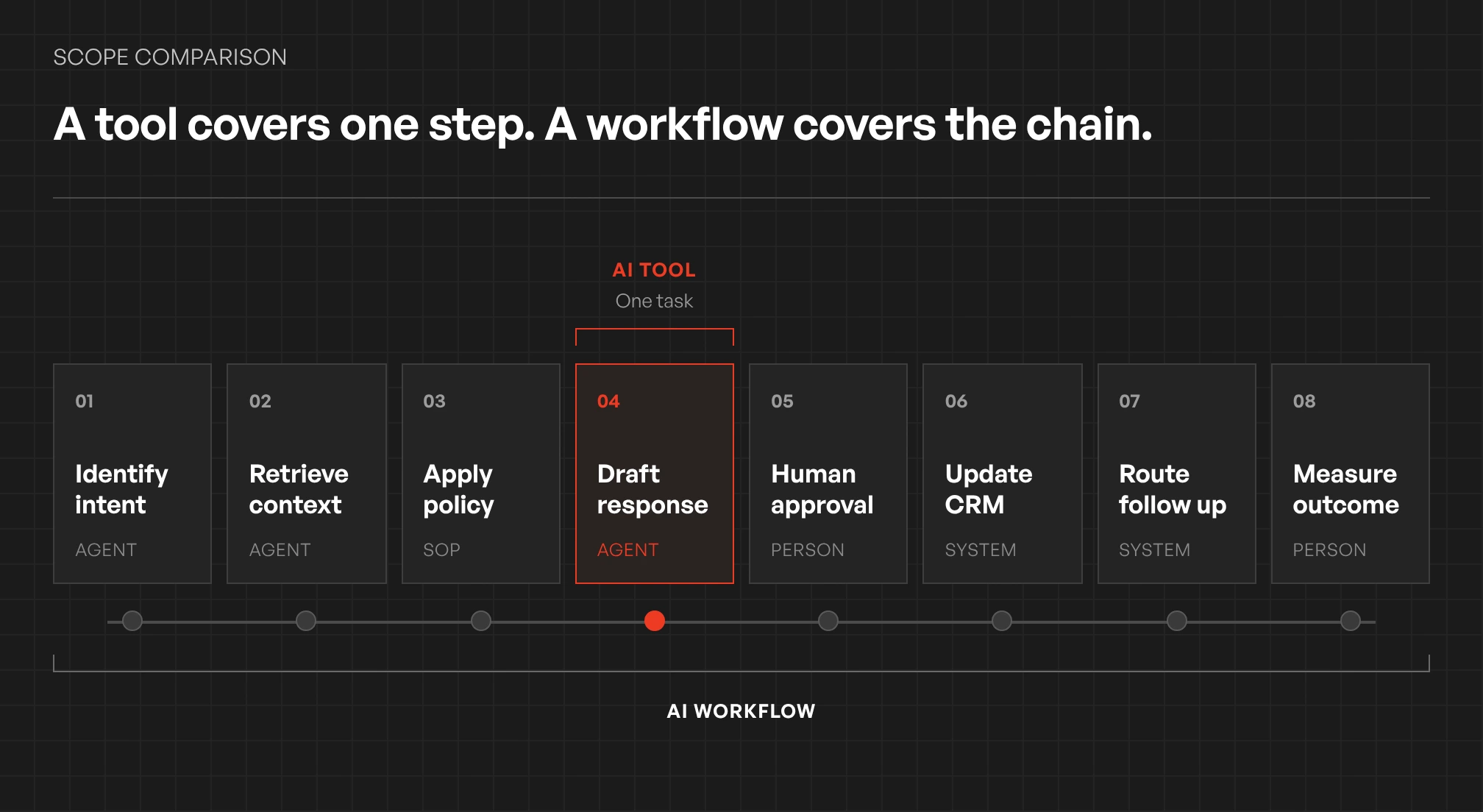
A task is only one step inside a workflow
A tool can produce a useful output for one task. A workflow includes the request, source data, classification, rules, roles, approvals, handoffs, system updates, exceptions, and measures that surround the task. If those layers remain manual or undefined, the tool may create speed at one point while increasing review, rework, or risk somewhere else.
Consider a customer inquiry. Drafting a response is only one step. The business must identify intent, retrieve the right account context, apply policy, determine whether human approval is required, send the response, update the CRM, route follow up, record the outcome, and learn from exceptions. The workflow is the product. The model is one component.
Workflow redesign starts with the demanded outcome
The first question should be what business outcome needs to improve. It may be response time, accuracy, throughput, conversion, customer satisfaction, cost, compliance, or employee capacity. Without a demanded outcome, teams tend to automate what is easy rather than what is valuable. They optimize isolated tasks without knowing whether the end to end process changed.
McKinsey has repeatedly found that workflow redesign is one of the strongest contributors to value from generative AI. The practical implication is that leaders must examine the sequence of work, not simply insert a tool. The process may need fewer steps, clearer ownership, better source data, new approval rules, or redesigned roles before automation can produce a reliable return.
Document the real process before automating it
Most organizations have a stated process and an actual process. The stated process lives in a procedure, diagram, or manager explanation. The actual process includes workarounds, hidden spreadsheets, judgment held by experienced employees, informal approvals, and exceptions resolved through private messages. Automating the stated process without observing the actual process creates brittle systems.
Workflow discovery should capture triggers, inputs, data sources, decision rules, role ownership, wait time, rework, exception types, handoffs, and output use. Subject matter experts should explain why steps exist and where judgment matters. The purpose is not to preserve every historical habit. It is to distinguish valuable operating knowledge from avoidable friction.
Design a human-led hybrid workforce
The strongest operating model assigns work according to comparative advantage. People own goals, judgment, accountability, relationships, ethical decisions, and important exceptions. AI agents support research, classification, summarization, recommendation, content transformation, monitoring, and high volume repeatable actions inside defined boundaries. Systems preserve state and move information to the next step.
This is not a replacement story. It is a role design story. When repetitive work is removed, employees can focus on decisions, customers, improvement, and expertise. When the role of the person is vague, teams either over delegate to AI or continue doing everything manually. A human-led hybrid workflow makes ownership visible and gives the AI component a constrained job.
- People own outcomes, judgment, approval thresholds, relationships, and exceptions.
- AI agents classify, retrieve, summarize, recommend, transform, monitor, and route within defined rules.
- SOPs preserve approved operating knowledge and decision logic.
- Data boundaries control which sources and records each agent may use.
- System handoffs update CRM, project, service, finance, or knowledge tools.
- Measures determine whether speed, quality, cost, conversion, or customer response improved.
Govern the source environment and the output path
A workflow is only as reliable as the sources it can use and the controls that govern output. The agent should know which documents, records, policies, and databases are authoritative. Access should match role and client boundaries. High consequence outputs should require review. Exceptions should route to named owners. Actions and source use should be logged enough to support audit and improvement.
Databricks reports that organizations using AI governance put far more projects into production and that evaluation tools are associated with substantially higher production rates. The lesson is not that every company needs enterprise complexity. It is that reliable use depends on explicit controls, not optimistic prompting.
Connect the workflow to the system of record
Many pilots fail because the output lives in a chat window. Someone still copies the result into the CRM, project board, support system, or document. That manual bridge limits scale and creates missing context. A production workflow should update the appropriate system, preserve relevant source and decision information, and trigger the next owned action.
Integration also creates accountability. Management can see throughput, response time, exceptions, approval rates, and outcomes. The workflow becomes measurable rather than anecdotal. This is where AI begins to behave like operating infrastructure instead of a personal productivity aid.
Evaluate the workflow against business measures
Accuracy remains important, but a business workflow needs more than a model score. Measure cycle time, human touch time, exception rate, rework, customer response, conversion, cost per completed item, policy compliance, and downstream quality. Compare the redesigned process with the prior baseline. Review whether the workflow moved the demanded outcome or merely shifted work.
Evaluation should continue after launch. Sources change, customer behavior changes, policies change, and teams discover new exception patterns. A workflow that performed well during a narrow pilot may degrade at greater volume or in different contexts. Continuous measurement turns the system into a learning operation rather than a one time implementation.
Change management is part of the architecture
Employees need to understand what is changing, why it matters, what remains theirs, and how success will be measured. If people believe the workflow exists only to remove jobs or monitor activity, adoption will be defensive. If they see that repetitive friction is being removed so they can focus on higher value work, the model becomes more credible.
Training should include process knowledge, source discipline, good prompting where relevant, review behavior, exception handling, and escalation. Managers need a cadence for inspecting results and improving the workflow. Technology cannot substitute for leadership communication and operating discipline.
The practical path is redesign, govern, integrate, and measure
The companies that capture value will not be those with the most AI tools. They will be those that can identify valuable recurring work, document the real process, assign human and AI roles, control data and decisions, connect systems, and measure business impact. The work is operational before it is technical.
That is why an AI readiness conversation should begin with workflows, not model comparisons. The right model may change. The operating logic, accountability, source quality, and management cadence are the durable assets. Build those well and the organization can adapt as the technology evolves.
Workflow value should be reviewed from the employee perspective
A workflow may meet its technical target and still fail adoption if it adds review burden, removes useful autonomy, or makes exceptions harder to resolve. Employees closest to the work should help evaluate whether the redesign improves the daily experience and preserves the judgment required for quality. Their feedback often reveals hidden steps and unintended consequences before they become customer problems.
The strongest change narrative is practical. The workflow removes low value repetition, improves access to information, clarifies ownership, and gives people more time for customers, decisions, and improvement. When employees can see that value, the organization develops AI fluency through use rather than through abstract training alone.
The workflow should preserve business context across steps
One reason disconnected tools underperform is that context disappears at every handoff. A summary does not include the decision made. A task does not include the customer history. A CRM update does not include the source evidence. A production workflow should preserve the minimum context required for the next person or agent to act correctly without reopening the entire history.
Context design improves both speed and quality. It reduces duplicate questions, inconsistent answers, and the tendency for employees to create private notes outside the system. It also makes audit and learning easier because the organization can trace how information moved from request to outcome.
Frequently asked questions
What is the difference between an AI tool and an AI workflow?
A tool assists one task. A workflow defines how work enters, uses data, moves through roles and systems, is validated, handles exceptions, and produces a measurable outcome.
What should humans continue to own?
People should own goals, judgment, accountability, relationships, approval thresholds, ethical decisions, and important exceptions.
Why do AI pilots fail to create value?
Common causes include weak process definition, poor source data, no integration, unclear ownership, missing governance, and no business measure tied to the workflow.
How should an AI workflow be measured?
Measure cycle time, human effort, accuracy, exception rate, rework, customer response, conversion, cost, compliance, and the business outcome the workflow was built to improve.
Sources & Further Reading
Move From AI Tools to a Working Business Workflow
Forward Thinkers can help redesign the work around clear outcomes, accountable people, reliable sources, system handoffs, and measurable performance. Explore Digital Transformation.
Sign up for our newsletter
Related posts


