
Proof Architecture for Complex B2B Decisions: What Hidden Buyers Need to See


The person in the sales conversation is not the entire buying group
Complex B2B opportunities often stall after a strong meeting because the visible contact is only one part of the decision. Other stakeholders may evaluate financial exposure, implementation risk, technology fit, operational disruption, legal terms, or executive priority. They may never attend the first conversation, yet their questions can determine whether the opportunity advances.
LinkedIn and Edelman research published in 2025 reported that more than forty percent of B2B deals stall because of buying group misalignment. This is why proof cannot be designed only for the primary user or champion. The company needs an evidence system that can travel into internal discussion and withstand scrutiny from people who did not hear the original pitch.
Proof is not a testimonial library
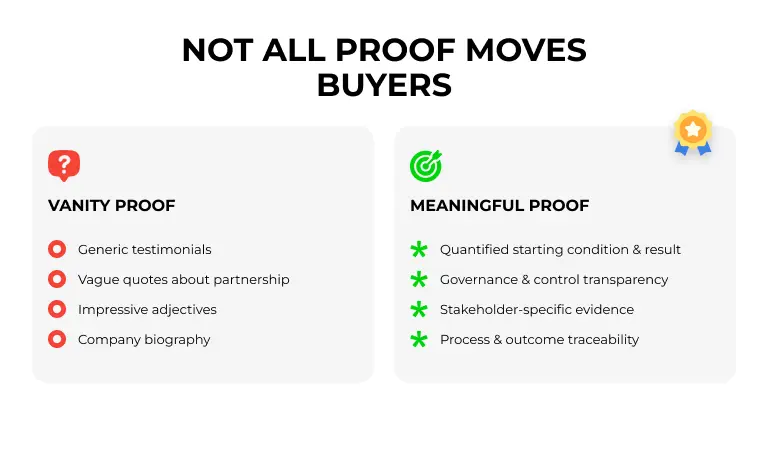
Testimonials are useful, but they are only one form of evidence. Proof architecture includes quantified results, starting conditions, methods, deliverables, timelines, before and after comparisons, operating controls, expert credentials, customer language, and transparent limitations. The right mix depends on the risk the buyer is evaluating.
A vague quote about great partnership may support reputation but do little for a finance leader questioning return, an operations leader questioning disruption, or an IT leader questioning governance. Proof becomes commercially useful when it answers a specific decision question.
Map proof to the stakeholder risk
The economic buyer needs to see business consequence, investment logic, measurable movement, and the cost of inaction. The operational buyer needs to see sequence, roles, dependencies, handoffs, and the impact on the team. The technical buyer needs to see data boundaries, integration logic, security, validation, and maintainability. The executive sponsor needs to see strategic alignment, leadership ownership, pace, and the path from intervention to outcome.
One asset will rarely answer all of these questions well. The architecture should provide a core proof story supported by stakeholder specific evidence. A case study may establish the result. A process visual may explain the operating approach. A governance diagram may reduce AI risk. A sales asset may help the champion build internal consensus.
Build case studies around the decision, not the company biography
Strong case studies begin with the starting condition and the constraint. They explain what leadership was trying to change, why previous activity was not enough, and what risk or complexity shaped the work. They then show what was built, how the pieces connected, and what measurable movement occurred.
The most useful structure is starting condition, constraint, intervention, operating change, measured result, and relevance to the next buyer. Industry and scale context help the reader judge comparability. Client confidentiality can be protected through sector based presentation while retaining enough specificity to be credible.
Place proof beside the claim and before the commitment
Proof loses value when it is buried in a separate page the buyer may never visit. A service page should show the evidence most relevant to that service. An AI workflow page should display governance controls and measurable workflow outcomes. A website service page should show decision architecture, representative pages, and conversion movement. A Growth Reset page should show how diagnosis changed priorities and execution.
The buyer should encounter evidence before being asked for a significant commitment. A proof module near the CTA can answer the final risk. A related case study can provide depth. An assessment can create personalized relevance. The architecture should support the decision at the moment rather than expecting the buyer to assemble the case alone.
Use thought leadership as evidence of decision quality
High-quality insight is a form of proof because it shows how the company thinks before the engagement begins. The 2025 Edelman-LinkedIn report found that 71 percent of hidden decision-makers said thought leadership was more effective than conventional marketing or sales materials at demonstrating a vendor’s potential value, while 64 percent considered it a more trustworthy basis for assessing capabilities. The value does not come from volume. It comes from helping the reader make a better decision through original analysis, clear tradeoffs, and practical operating guidance.
This is especially important when the service depends on judgment. A buyer cannot fully inspect advisory quality before purchasing. Articles, frameworks, executive commentary, and case explanations provide observable evidence of how the company diagnoses problems, handles complexity, and connects work to outcomes.
Design proof for internal sharing
Hidden buyers often encounter the company through a link, screenshot, forwarded deck, or summary from the champion. Proof should be easy to extract without losing meaning. Use clear headlines, concise result statements, visible source context, and modular visuals. Avoid proof that depends on a long live explanation.
Create consensus assets for important buying decisions. A one page decision summary can show the problem, outcome, approach, proof, risk controls, and next step. A short video can explain the system. A case card can highlight sector, scale, intervention, and result. These assets help the champion carry the story into rooms where sales is not present.
Govern proof so credibility compounds
Every proof asset should have an owner, source, permission status, review date, and approved claim. Results must be traceable. Anonymous case studies should protect confidentiality without overstating what can be verified. Testimonials and endorsements should follow applicable disclosure and truthfulness requirements.
Proof also needs refresh discipline. Old results may remain relevant, but the page should show current operating capability and recent evidence where possible. Governance protects the brand from unsupported claims and makes the evidence library easier for content, sales, and AI systems to use accurately.
- Economic proof: revenue, cost, margin, time, risk, or enterprise value movement.
- Operating proof: process, ownership, handoff, adoption, and execution improvement.
- Technical proof: controls, integrations, data boundaries, testing, and reliability.
- Authority proof: original insight, named expertise, frameworks, and decision quality.
- Social proof: client language, references, endorsements, and stakeholder validation.
- Consensus proof: portable assets that help the champion align the buying group.
The commercial goal is confidence that survives scrutiny
The objective is not to make the company look impressive. It is to give each stakeholder enough credible evidence to support the next decision. When proof is designed as architecture, it reduces repeated explanation, strengthens internal consensus, and makes the buying experience more efficient.
A company with strong proof does not need to rely on adjectives or aggressive claims. The evidence carries the story. That is a durable advantage in a market where buyers, search systems, and AI tools are all trying to determine which sources are specific, trustworthy, and worth citing.
Proof should also show how the work is governed
For complex services and AI-enabled work, buyers increasingly need evidence of control, not only outcome. Show how ownership, validation, approvals, data boundaries, review routines, and exception handling protect the result. This helps sophisticated stakeholders distinguish a repeatable operating capability from a one time success or an unsupported promise.
Governance proof is especially valuable when the engagement changes workflows or customer-facing systems. A buyer can accept that no implementation is risk free while still requiring confidence that risks will be identified, owned, and managed. Clear operating controls make the proof more credible because they explain how the result was produced.
Use proof to reduce the cost of internal consensus
Complex deals consume time because the champion must gather evidence, answer internal questions, and align stakeholders who may never attend a sales call. Well designed proof reduces that coordination burden. It gives the champion credible language and portable assets that can move through finance, operations, IT, legal, procurement, and executive review.
The commercial benefit is not only higher conversion. It is a more efficient decision process. Sales spends less time recreating custom explanations, buyers experience fewer information gaps, and leadership can see which proof assets consistently support movement across the buying group.
Proof architecture should influence content priorities
Editorial planning should begin with the claims the business needs to support and the questions hidden buyers must answer. Articles can then explain tradeoffs, implementation, governance, and measurable outcomes that case studies alone cannot cover. This makes thought leadership part of the proof system instead of a separate awareness activity.
Proof should be tested in active opportunities
The strongest proof architecture is reviewed against real sales conversations. Ask which assets prospects opened, which evidence champions forwarded, which questions remained unresolved, and where hidden stakeholders slowed the decision. This feedback shows whether the proof is placed and structured correctly rather than merely present on the website.
Sales and marketing should review these patterns together. The purpose is not to customize every asset for every deal. It is to improve the reusable evidence system so future buyers encounter stronger answers earlier and the organization learns from every important decision.
Frequently asked questions
What is proof architecture?
It is the coordinated system of case evidence, results, process, expertise, controls, and stakeholder specific assets used to reduce risk across the buyer journey.
Who are hidden buyers?
Hidden buyers are internal stakeholders who influence or approve a purchase even when they are not the primary user or visible contact in the sales process.
What should a B2B case study include?
Include the starting condition, constraint, intervention, operating change, measurable result, sector and scale context, and relevance to the next buyer.
How should proof be governed?
Every asset should have a source, owner, permission status, approved claim, review date, and clear relationship to the page or decision it supports.
Sources & Further Reading
Strengthen the Proof Behind Complex Decisions
Forward Thinkers can help organize case evidence, thought leadership, process transparency, and stakeholder-specific proof into a system buyers can confidently share. Start a Proof Strategy Conversation.
Medium length heading goes here
Lorem ipsum dolor sit amet, consectetur adipiscing elit.
Medium length heading goes here
Lorem ipsum dolor sit amet, consectetur adipiscing elit.