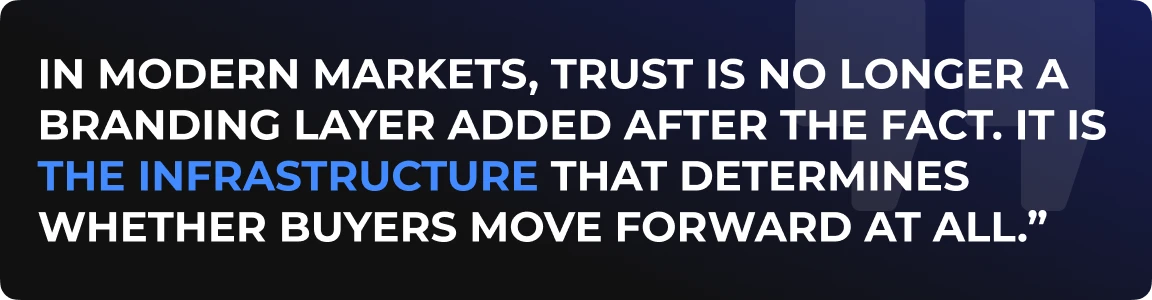
Trust Signals Are the New Conversion Infrastructure


Every conversion is a risk decision. The buyer may like the message, understand the offer, and still hesitate because the downside of being wrong feels larger than the upside of acting. That is why trust signals have become so important. They are not decorative elements added near the bottom of a page. They are conversion infrastructure. They help the buyer cross the gap between interest and confidence.
Why trust now sits closer to the point of conversion
Trust has moved closer to the point of decision because buying journeys are more self directed than before. By the time a prospect reaches a service page or a contact form, much of the early research may already have happened through search, AI summaries, referrals, social validation, and internal discussion. Forrester notes that many buyers enter the process with a front runner in mind. In that environment, weak trust architecture does not simply reduce conversion rates. It may prevent the company from ever becoming the preferred option in the first place.
Which signals reduce perceived risk
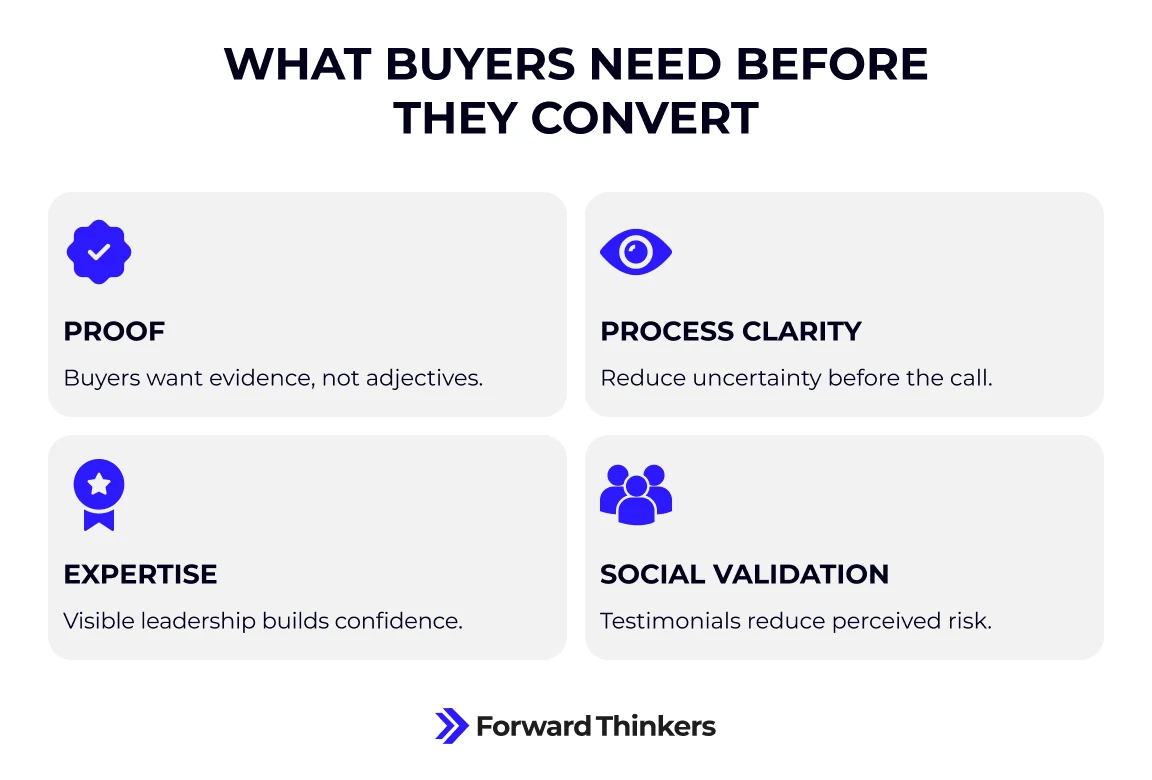
Trust signals reduce perceived risk in different ways:
- Evidence of outcomes reduces performance risk.
- Visible process reduces uncertainty risk.
- Testimonials and case studies reduce social risk by showing that others made the same decision successfully.
- Certifications, experience, and specialist credentials reduce competence risk.
- Transparent pricing language, scope clarity, and realistic claims reduce disappointment risk.
The right trust stack depends on the decision being made and the stakes of the purchase.
What weak trust architecture looks like
What weak trust architecture looks like is easy to spot. Generic claims with no measurable support. Vague headlines that do not identify who the company serves. Contact pages that ask for a call before the reader understands the process. Thin service pages with no examples, no team visibility, and no adjacent proof. Reviews placed in random places without context. Sites that force the buyer to infer too much.
The common failure is not that the company lacks proof. The common failure is that proof is not structured where the buyer needs it most.
Ready to bridge the gap between interest and buyer confidence? Contact our team today to evaluate your brand's digital credibility.
How to build proof into digital journeys
This matters even more as AI becomes part of discovery. AI systems often compress information, which means the clearest and most repeated proof signals gain disproportionate value. If your site consistently pairs strategic claims with concrete outcomes, industry specificity, and leadership expertise, both buyers and machines have stronger material to interpret. If your claims are broad and unsupported, summaries may flatten your differentiation further. Trust therefore affects not only conversion once someone arrives, but also how your brand is represented before they do.
Deloitte has shown that consumers reward innovation when it is paired with data responsibility and trust. The principle extends beyond consumer technology. Across categories, organizations want to know whether a company is credible, careful, and capable of delivering what it promises. That means trust signals should also include privacy posture, responsible data use, security language where relevant, and a tone of clarity rather than exaggeration. Overclaiming is expensive because it raises skepticism and invites scrutiny you may not be ready to satisfy.
How trust connects to growth economics
Operationally, trust should be designed into the journey. Put credential and process signals near high intent conversion points. Match testimonials to the offer and audience on the page. Use case studies that show the tension, the intervention, and the outcome. Publish leadership perspectives that explain how the company thinks, not only what it sells. Add FAQs that resolve common anxieties before they become objections in sales. This is one of the highest return uses of content because it improves conversion without always requiring more traffic.
Companies often chase more leads when the smarter move is reducing the uncertainty that suppresses the leads they already earned. Trust signals do exactly that. They convert confidence from an abstract brand aspiration into visible infrastructure that helps buyers act. In a market flooded with options, that is one of the strongest commercial advantages a company can build.
Practical Expansion
Trust infrastructure also deserves the same intentional design attention that teams usually give to campaign creative. A powerful headline can earn attention, but if the page does not then answer who this is for, how the process works, what outcomes have been achieved, and what risk has been reduced for similar clients, the attention does not convert into confidence. In higher consideration categories, that confidence gap is often the hidden reason why strong traffic underperforms. The visitor is interested, but the proof stack is not strong enough to justify movement.
It is useful to think of trust as cumulative rather than singular. One testimonial helps. A visible expert profile helps. A case study helps. A clear process explanation helps. A privacy statement helps. A consistent tone helps. None of these alone may close the gap, but together they create the sense that the company is serious, transparent, and credible. That cumulative effect is why trust should be designed across the journey instead of being treated as one isolated proof module on the page.
A practical operating move is to perform a trust walk on every high intent page. Read the page as a skeptical buyer would. Note where uncertainty remains, where claims are unsupported, and where the next step feels risky or premature. Then close those gaps with proof, process, specificity, and clarity. This exercise is often more profitable than redesigning the page cosmetically because it targets the real source of hesitation.
This matters for brand reputation over time as well. Every high friction digital interaction teaches the market something about how the company probably works offline. If pages feel evasive, exaggerated, or thin on proof, buyers often assume the engagement itself may feel the same. If pages feel candid, specific, and thoughtfully structured, the company earns a credibility premium before a salesperson enters the conversation. Trust signals therefore do more than lift immediate conversion. They shape how the brand is pre judged in future opportunities and referrals.
For service firms, trust infrastructure should be treated as part of the sales process before the sales conversation begins. The website, the article library, the team page, and the proof stack are already doing pre sales work long before a prospect fills out a form. Investing in those assets is therefore not a side project for marketing. It is a direct investment in conversion quality and sales efficiency because better informed, more confident buyers usually move faster and ask better questions.
Execution Checklist
- Identify the top conversion pages and review them through a risk reduction lens.
- Match testimonials and case proof to the specific offer and audience on the page.
- Explain process, timeline, or engagement path before asking for commitment.
- Add leadership expertise and credentials where trust depends on specialist judgment.
- Refresh proof assets regularly so signals remain current and believable.
Leader Questions to Pressure Test the Strategy
- What risk remains in the buyer’s mind at the moment we ask them to act?
- Which pages still rely on adjectives instead of evidence?
- Where do we force a prospect to trust us before we have earned it?
Those questions help teams improve conversion by reducing uncertainty instead of only redesigning layout or chasing more traffic.
FAQ Section
What counts as a trust signal?
Case studies, testimonials, reviews, leadership expertise, process clarity, credentials, and transparent messaging all function as trust signals.
Why do trust signals affect conversion so strongly?
They reduce perceived risk and help the buyer feel more confident that the decision is safe, credible, and likely to produce the promised outcome.
Where should trust signals appear?
They should appear on high intent pages, near calls to action, inside service narratives, and throughout the journey where buyers evaluate risk.
What This Unlocks Next
The next growth constraint is rarely isolated. Once this issue is addressed, the next question is how to strengthen the next layer of the brand, authority, revenue, and execution system.
Read the next article in the Forward Thinkers series: Message Architecture for Multi Channel Growth