
The ROI of Proper M&A Analysis: Why Due Diligence Determines Deal Success


Introduction: Most Deals Are Evaluated Backwards
In many acquisitions, the financials are reviewed first and the operational reality is discovered later.
Traditional due diligence focuses on:
- revenue
- profit
- assets
- liabilities
But modern businesses, especially service, technology, and digital companies, derive value from systems, processes, and infrastructure that rarely appear on a balance sheet.
This is where proper M&A analysis changes the outcome of a deal.
What Traditional Due Diligence Misses
Financial statements show historical performance. They do not show operational sustainability.
Two companies can report identical revenue yet require completely different effort and cost to operate.
Key risks often hidden include:
- fragile lead generation sources
- undocumented workflows
- platform dependency risk
- unscalable processes
- unsupported technology stacks
- inaccurate projections
Without evaluating these, buyers purchase performance that cannot be repeated.
The Role of Modern Operational Analysis
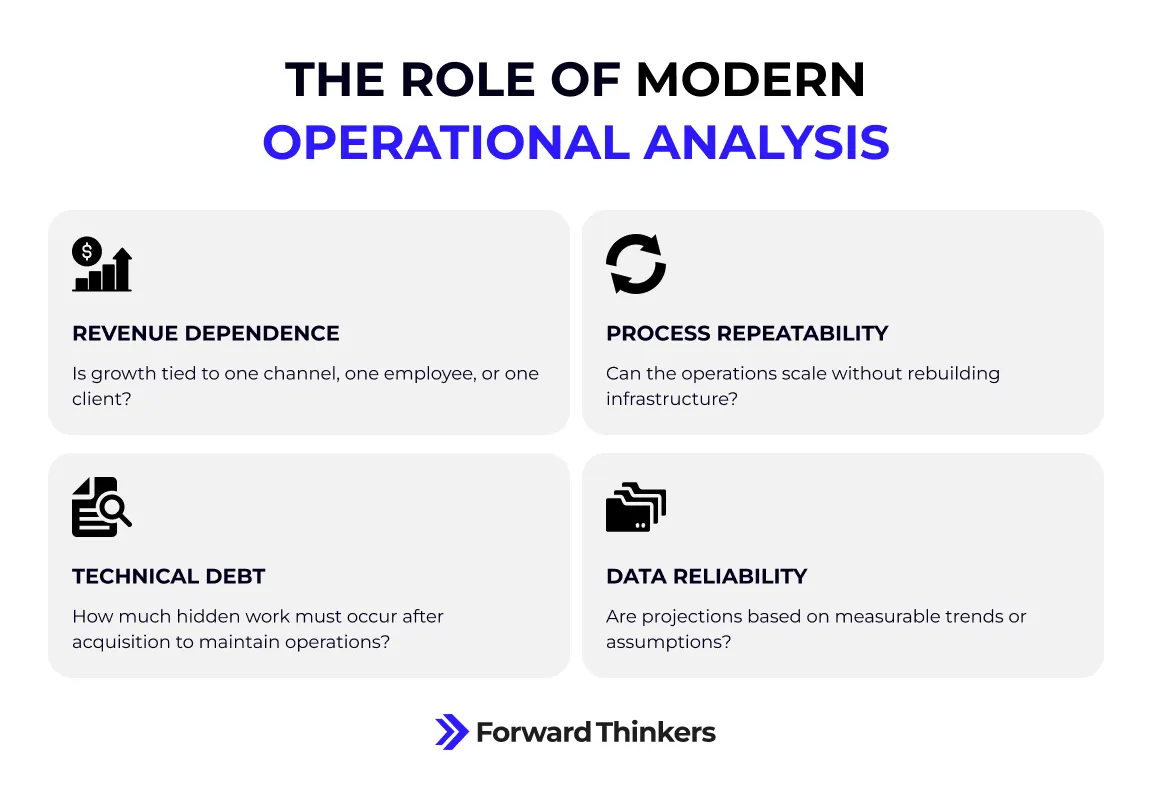
Modern due diligence evaluates how the business actually functions day to day.
Instead of asking “What did it earn?”
It asks “Why did it earn it?”
This includes reviewing:
Revenue Dependence
Is growth tied to one channel, one employee, or one client?
Process Repeatability
Can the operations scale without rebuilding infrastructure?
Technical Debt
How much hidden work must occur after acquisition to maintain operations?
Data Reliability
Are projections based on measurable trends or assumptions?
This determines whether a company is turnkey, transitional, or distressed.
Understanding Technical Debt in Acquisitions
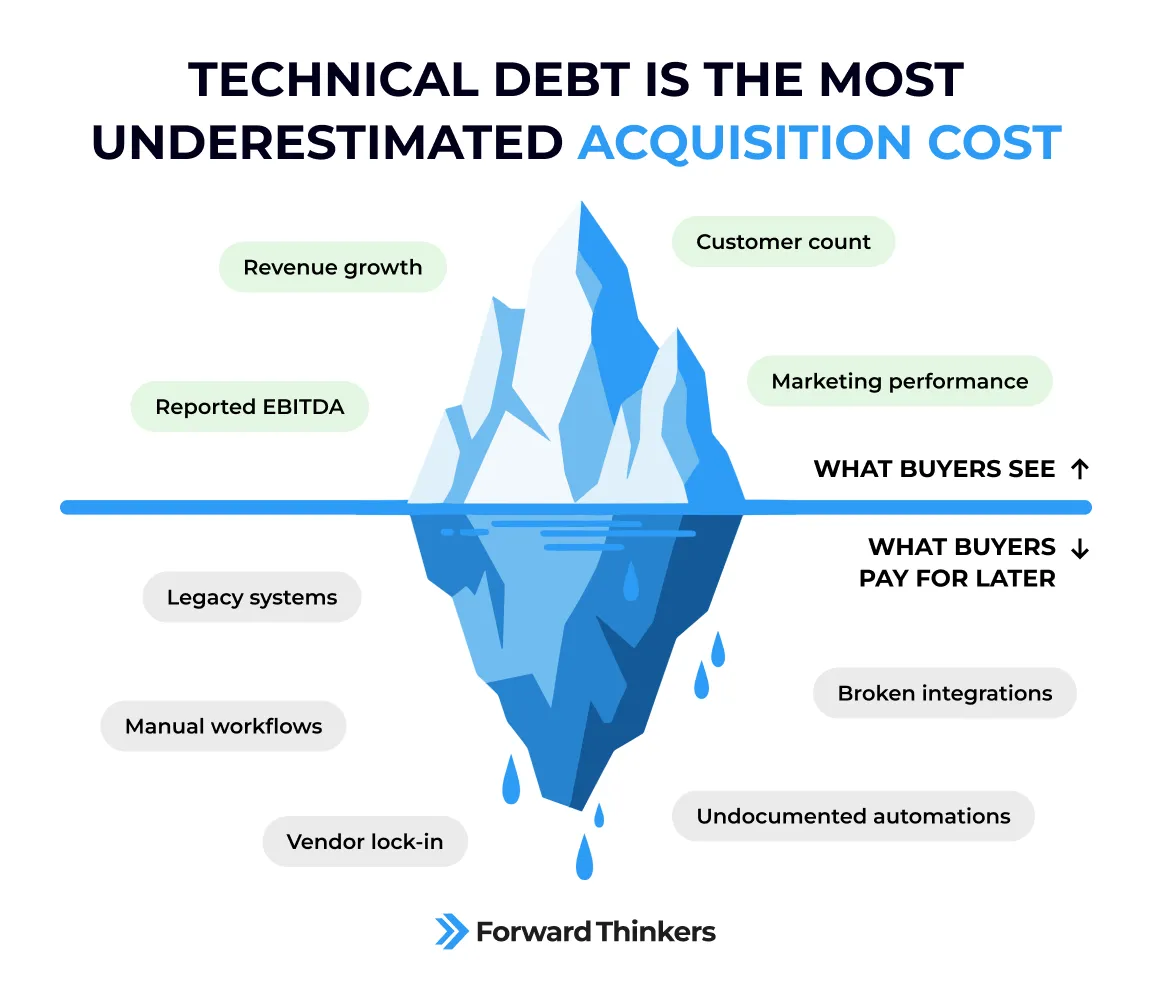
Technical debt is the most underestimated cost in modern acquisitions.
It can appear as:
- outdated software environments
- manual workflows
- disconnected systems
- undocumented automations
- fragile integrations
These don’t reduce revenue immediately, they reduce profitability and scalability after the purchase.
Buyers often pay growth multiples for companies that require reconstruction.
How Proper Analysis Changes Negotiations
When the operational structure is understood, the buyer gains clarity on:
- true operational cost
- timeline to stability
- required investment after acquisition
- realistic revenue projections
This frequently shifts a deal from:
“growth acquisition” → “stabilization acquisition”
The valuation may not disappear, but the structure changes.
Real Value: Not Preventing Deals, Structuring Them
The goal of M&A analysis is not to reject acquisitions.
It is to determine the correct purchase model:
Deals succeed when expectations match operational reality.
The Financial ROI of Due Diligence
Proper analysis produces measurable returns:
Prevented Overvaluation
Avoid paying for projected performance that cannot occur.
Negotiation Leverage
Adjust price or structure based on verified conditions.
Faster Integration
Prepare operational roadmap before closing.
Reduced Post-Acquisition Loss
Avoid unexpected rebuild costs.
In many cases, the value of analysis exceeds the cost of the entire diligence process.
Why Digital Businesses Require Deeper Review
Modern companies operate on invisible infrastructure:
- marketing systems
- CRM pipelines
- integrations
- automation workflows
- hosting environments
- vendor dependencies
These systems determine whether revenue continues after ownership changes.
Ignoring them is equivalent to purchasing equipment without inspecting whether it works.
Conclusion
Acquisitions fail less often because the idea was wrong and more often because the structure was misunderstood.
Proper M&A analysis aligns price, expectations, and operational reality. Instead of discovering risk after closing, buyers understand exactly what they are purchasing, and how to operate it successfully.
The return on diligence is not just avoiding bad deals. It is turning uncertain deals into predictable investments.