Message Architecture for Multi Channel Growth


As brands grow, messaging usually gets louder before it gets clearer. More campaigns launch. More channels appear. More teams start speaking on behalf of the company. Unless there is a disciplined message architecture underneath, the result is inconsistency disguised as activity.
The homepage says one thing, paid ads say another, sales decks say a third, and customer success introduces a fourth interpretation in onboarding. The business assumes it has a promotion challenge when in reality it has a language system failure.
Why message consistency breaks at scale
Message architecture is the operating structure that prevents that breakdown. It defines the core claim the brand wants to own, the proof that supports it, the audience variations that make it relevant, and the channel adaptations that allow flexibility without distortion. It is not a tagline exercise. It is the logic model behind all market facing communication. Without it, every new asset becomes a fresh debate rather than an extension of a known strategic truth.
The need for message architecture has intensified because buyers encounter brands in fragments. Search snippets, AI answers, paid headlines, social posts, webinar clips, email subject lines, service page intros, and referral explanations all carry portions of the story. If those fragments do not align, the buyer has to reconstruct the meaning on their own. Most do not. They move on to the company whose story is easier to understand and easier to repeat internally.
What message architecture actually includes
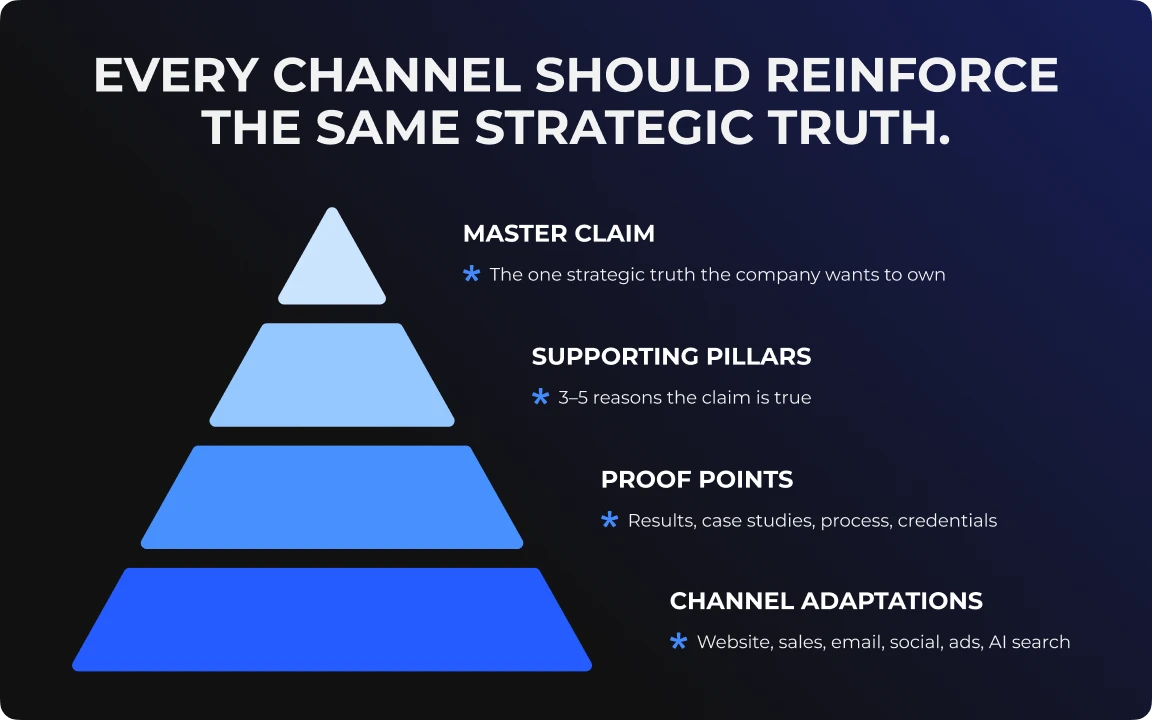
A good architecture typically has four levels:
- The master claim: The strategic statement about the value the company uniquely creates.
- Supporting pillars: Usually three to five ideas that explain how that value is delivered.
- Proof points: Outcomes, examples, process, credentials, and differentiators.
- Audience adaptations: Allow the message to shift emphasis based on role, industry, or buying stage without abandoning the core logic.
This structure gives teams enough flexibility to stay relevant while protecting the message from random drift.
How to adapt without diluting
Message architecture also improves performance because it reduces reinvention. Campaign briefs are faster to write. Service pages align naturally. Content planning gets easier because editorial themes map back to a known set of strategic pillars. Sales talk tracks become more coherent. Even hiring and onboarding improve because employees learn how to explain the company consistently. In that sense, message architecture is not just a brand tool. It is a scaling tool.
Is your brand story changing every time a different team tells it? Contact Forward Thinkers to build a scalable message architecture.
Where AI can support message discipline
AI can support this work well if used carefully. It can compare messaging across assets, surface inconsistencies, classify claims by theme, and help teams repurpose content while preserving the hierarchy of meaning. It can also analyze customer language to show whether the company’s message matches how the market actually describes the problem.
What AI should not do independently is create the strategic core. That decision still belongs to people who understand the market, the delivery model, and the commercial stakes of being misunderstood.
How to audit the system
The audit for message architecture is straightforward. Review your homepage, top service pages, best performing campaigns, sales deck, and recent outbound sequence.
- Ask whether the same core claim appears consistently.
- Ask whether proof is visible and believable.
- Ask whether the audience language is adapted intelligently or whether each team has invented its own vocabulary.
If the answers vary widely, the company does not have message architecture. It has message inventory.
Multi channel growth becomes much easier when every channel carries a shared strategic logic. Buyers do not need the brand to say the exact same sentence everywhere. They need the brand to mean the same thing everywhere. That is the job of message architecture, and companies that build it early usually grow with far less wasted effort.
Practical Expansion
Message architecture becomes even more important when companies begin segmenting by audience or expanding into adjacent offers. The temptation is to let each segment create its own message stack. Sometimes that feels customer centric, but it often destroys cohesion because the business ends up sounding like several unrelated companies. A disciplined architecture allows emphasis to shift by audience while the underlying strategic meaning stays intact. That balance is what makes multi channel growth feel coherent instead of improvised.
There is also a practical benefit for internal productivity. When teams know the master claim, the approved pillars, and the proof standards, they move much faster. Briefs become shorter, revisions become more targeted, and disagreements become easier to resolve because everyone can refer back to the same system. In that sense, message architecture reduces organizational drag. It is not a creative constraint. It is an execution advantage that frees teams to adapt intelligently without resetting the strategic debate every time a new asset is created.
Leaders should treat message architecture as a living commercial system. Review it when the market changes, when a new service line emerges, or when win loss analysis shows that the market is misunderstanding your value. Update carefully, then train broadly. The goal is not to preserve old language for its own sake. The goal is to ensure that when the story changes, it changes deliberately and reaches every important touchpoint.
Message architecture is also one of the best defenses against channel noise created by rapid growth. New hires, new vendors, new offers, and new AI tools all introduce ways for the story to drift. A mature architecture gives the business a reference point that outlives any single campaign. That continuity matters because trust in the market is partly built through repetition. Buyers gain confidence when different touchpoints reinforce one another. They lose confidence when every touchpoint sounds like a different company using a different theory of value.
This is why message architecture should be visible beyond marketing. Operations should understand the promises being made. Sales should understand which proof points matter most. Client service should know which language needs reinforcement after the deal closes. When the architecture is shared broadly, the organization creates a much stronger echo effect. Buyers hear one consistent story, and employees understand how their work supports that story. That alignment is difficult for competitors to imitate once it is embedded.
Message architecture also improves measurement because teams can evaluate whether the same strategic narrative is creating response across multiple channels. When every asset uses different language, performance data becomes harder to interpret. When the architecture is stable, leaders can see more clearly which pillars resonate, which proof points move buyers, and where adaptation is helping or hurting. That turns messaging from a subjective debate into a more teachable commercial system.
Execution Checklist
- Define the master claim, supporting pillars, and proof standards in one shared document.
- Audit homepage, service pages, sales deck, and outbound language against that document.
- Allow audience adaptation only when the core logic remains intact.
- Use AI tools to detect message drift across assets and channels.
- Retrain internal teams whenever major message changes are approved.
Leader Questions to Pressure Test the Strategy
- Can every major team explain the same core claim in language that sounds recognizably related?
- Are our campaigns adapting the message intelligently or replacing it?
- Do our proof points support the exact promises being made in market?
These questions quickly reveal whether the company has a message system or just a collection of active assets.
FAQ Section
What is message architecture?
It is the structured hierarchy of core claim, proof, audience adaptation, and channel expression that keeps brand communication aligned.
Why does it matter for growth?
Because buyers encounter the brand across many channels and fragments. Strong architecture makes the story easier to understand, trust, and remember.
How can AI help message architecture?
AI can analyze consistency, classify themes, and support adaptation, but human leaders should still define the strategic core and approve major changes.
What This Unlocks Next
The next growth constraint is rarely isolated. Once this issue is addressed, the next question is how to strengthen the next layer of the brand, authority, revenue, and execution system.
Read the next article in the Forward Thinkers series: Brand Governance for Scale, How to Grow Without Fragmenting the Story