
Learn why marketing breaks without proper infrastructure.


Why Most Marketing Fails Without Infrastructure (And How to Fix It)
Many companies invest heavily in marketing and still struggle to generate consistent results. Campaigns launch, traffic increases, and content gets published—yet revenue growth stalls or feels unpredictable.
The problem is rarely effort.
It’s almost always infrastructure.
Marketing that isn’t supported by strong digital infrastructure becomes fragmented, hard to measure, and impossible to scale. Without systems underneath it, even great campaigns eventually break.
Marketing Is Only as Strong as the Systems Behind It
Most businesses think of marketing as channels:
- Ads
- Social media
- Email
- Content
But channels are just the surface layer. Underneath them sit systems that determine whether marketing actually works:
- Website architecture
- Analytics and attribution
- CRM and lead routing
- Automation and follow-up
- Data cleanliness and visibility
When these systems aren’t aligned, marketing becomes disconnected from sales and operations—creating friction instead of momentum.
The Hidden Cost of Campaign-First Marketing
Campaign-first marketing focuses on short-term execution:
- Launch the ads
- Publish the blog
- Send the emails
Without infrastructure, this approach often leads to:
- Leads falling through the cracks
- Inconsistent follow-up
- Conflicting data between platforms
- Decisions made on incomplete or misleading metrics
Over time, teams lose confidence in the data and rely more on instinct than insight.
Why Infrastructure Comes Before Scale
Scaling marketing without infrastructure is like increasing traffic on a bridge that hasn’t been reinforced.
Before scale, companies need:
- Clear conversion paths
- Reliable tracking across channels
- Defined lead qualification rules
- Ownership between marketing and sales
Infrastructure doesn’t slow marketing down—it removes the friction that causes it to stall later.
What Marketing Infrastructure Actually Includes
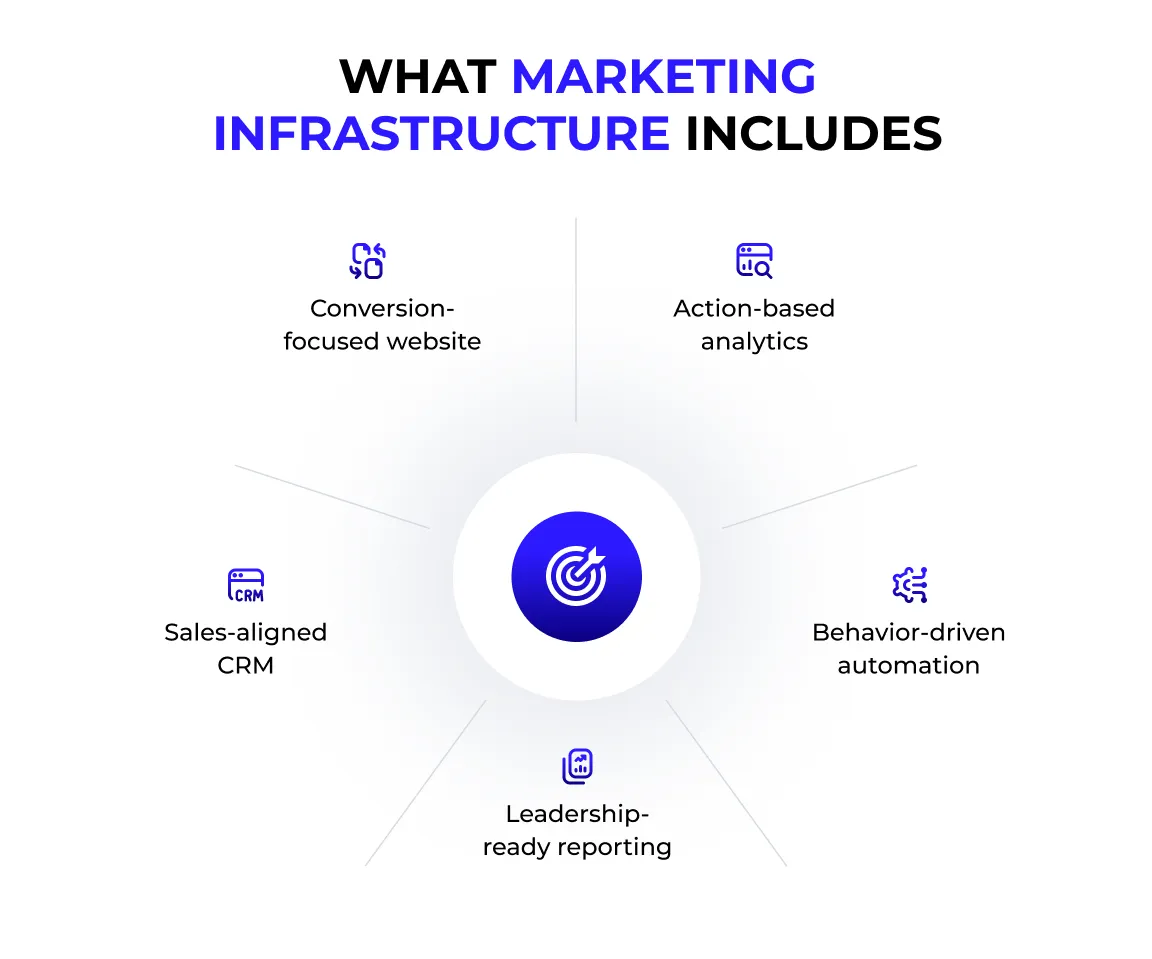
Marketing infrastructure isn’t a single tool. It’s a connected system designed around the customer journey.
Key components include:
- A website built for conversion, not just aesthetics
- Analytics configured to track meaningful actions
- CRM systems that reflect how sales actually works
- Automation that responds to behavior, not just time
- Reporting that leadership can trust
When these pieces work together, marketing becomes repeatable instead of reactive.
The Shift From Campaigns to Systems
Companies that mature their marketing eventually shift focus:
- From individual campaigns → to lifecycle systems
- From vanity metrics → to revenue signals
- From manual processes → to automation and workflows
This shift allows teams to:
- Launch faster without breaking things
- Measure performance accurately
- Improve continuously instead of restarting every quarter
Marketing becomes an operating system—not a series of experiments.
How Forward Thinkers Approaches Marketing Infrastructure
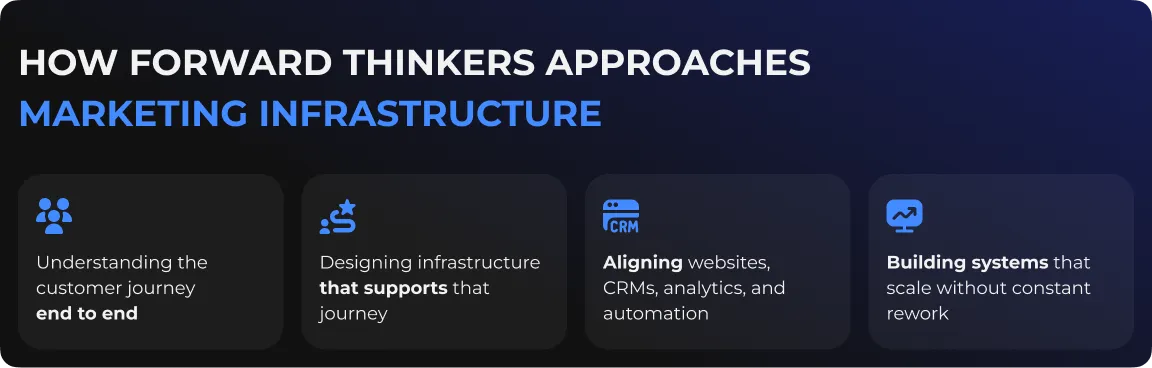
At Forward Thinkers, marketing is treated as an interconnected system.
Instead of starting with tactics, the focus is on:
- Understanding the customer journey end to end
- Designing infrastructure that supports that journey
- Aligning websites, CRMs, analytics, and automation
- Building systems that scale without constant rework
Campaigns still matter—but they’re built on a foundation designed to support growth, not just activity.
When It’s Time to Rethink Your Marketing Foundation
It’s often time to reassess infrastructure when:
- Leads are coming in but not converting
- Reporting feels inconsistent or unreliable
- Sales and marketing operate in silos
- Growth depends on constant manual effort
These aren’t marketing failures—they’re system failures.
Fixing the foundation turns marketing into a predictable growth engine instead of a recurring fire drill.
Marketing That Compounds Instead of Resets
Strong marketing infrastructure allows progress to compound. Each campaign builds on the last. Each insight informs the next decision.
When systems are aligned, marketing stops feeling fragile—and starts working the way it was always supposed to.