Market Story to Customer Decision: How to Move Buyers From Relevance to Action


A brand story is not automatically a customer decision system
Companies often invest in brand language that sounds credible but does not change how a buyer evaluates the business. The story may explain purpose, history, values, capabilities, and ambition. Those elements can strengthen identity, but the buyer still needs help making a commercial decision. The market story must translate what the company believes into what the customer can recognize, verify, and act on.
This distinction is important because B2B decisions are rarely made by one person in one moment. The primary contact may understand the value while finance questions the economics, operations questions implementation, IT questions risk, and an executive sponsor questions strategic fit. A useful story must travel across that buying group without changing meaning.
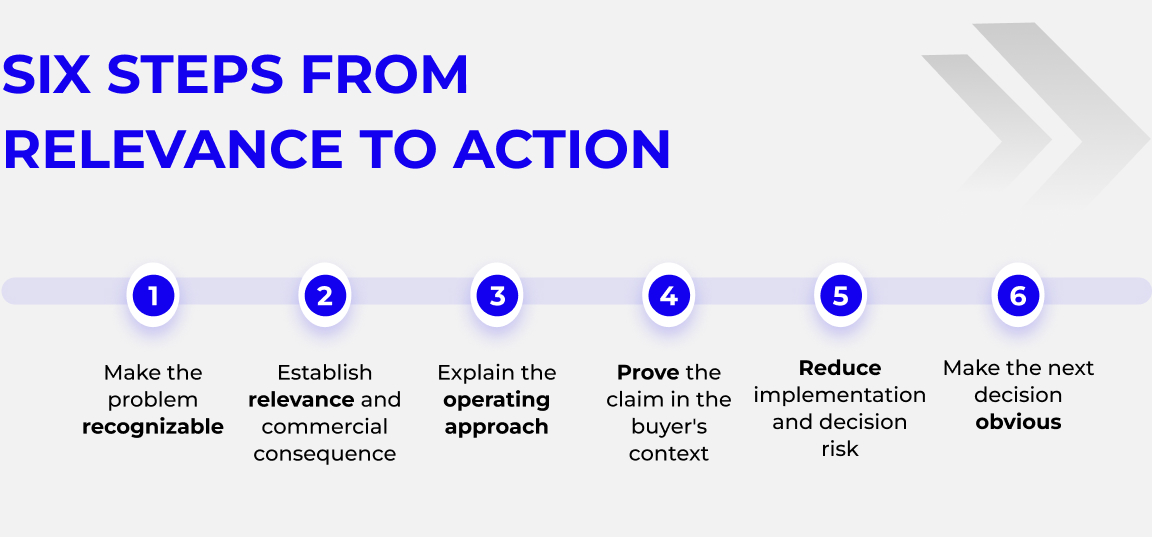
Stage one: Make the problem recognizable
The first stage is not awareness of the company. It is recognition of the problem. Buyers pay attention when language reflects what they are experiencing. Slow pipeline, weak conversion, scattered tools, manual work, inconsistent follow up, and unclear accountability are visible symptoms. The story should help explain the underlying commercial tension without pretending every symptom has the same cause.
Recognition requires specificity. Generic language about transformation or growth can apply to almost any business. Strong language names the operating condition, the consequence, and the audience. It gives the buyer a reason to continue because the company appears to understand the situation before proposing a solution.
Stage two: Establish relevance and commercial consequence
A problem can be real without being urgent. The market story must connect the condition to what leadership cares about. Unclear positioning increases the cost of promotion and sales education. Weak proof slows consensus and creates price pressure. Broken handoffs allow qualified demand to decay. Undocumented workflows create labor exposure and make automation unreliable. Poor management cadence turns initiatives into recurring status meetings without decisions.
The consequence should be expressed in business language, not exaggerated fear. The goal is to help the buyer understand why the issue deserves action and what may happen if it remains unresolved. This is where the story moves from description to relevance.
Stage three: Explain the operating approach
Buyers need to understand how the company thinks and works. A list of services is not enough. The operating approach should show the sequence used to diagnose, build, connect, activate, and manage. It should make boundaries visible so the buyer understands what the engagement includes and what it does not.
For Forward Thinkers, the operating approach connects market story, customer conversion, integrated sales execution, human-led AI workflows, and management cadence. The point is not to introduce another framework name for its own sake. The framework helps the buyer see how separate issues fit into one commercial system and where the starting constraint may sit.
Stage four: Prove the claim in the buyer’s context
Proof is strongest when it mirrors the buyer’s decision. A company evaluating a website and demand system needs to see how positioning, pages, campaigns, and sales assets were connected. A company evaluating AI workflow needs to see process design, data boundaries, human review, validation, system updates, and measures. A company evaluating Growth Reset needs to see how a diagnosis produced a prioritized path and measurable operating change.
Case studies should show the starting condition, what was built, what changed, and the measured result. Anonymous proof can still be credible when the sector, scale, constraint, intervention, and outcome are specific. The story should not ask the buyer to trust a claim that the site can demonstrate.
Stage five: Reduce implementation and decision risk
Buyers often agree with the strategic idea and still hesitate because the path feels risky. They may worry about disruption, internal bandwidth, data access, leadership alignment, scope creep, or the ability to sustain the change. The market story should answer those concerns before they become hidden objections.
Risk reduction can come from process clarity, defined deliverables, decision gates, role expectations, privacy language, governance standards, and a clear explanation of what happens next. The tone matters. Realistic boundaries build more trust than a promise that transformation will be easy.
Stage six: Make the next decision obvious
The next action should match the buyer’s readiness. A lower readiness visitor may complete a scorecard or read a proof story. A leader evaluating AI may take a readiness assessment. A qualified company with urgency and context may apply for a Growth Reset or service review. A general inquiry should use Contact. The story should guide these paths rather than treating every visitor as ready for a sales call.
The action should also explain what happens after the click. Buyers are more likely to move when they know what will be reviewed, who will respond, what information is needed, and whether there is an obligation to continue. A CTA is stronger when it reduces uncertainty rather than simply commanding action.
The story must survive across channels and people
A market story is only useful if it remains coherent across the website, executive voice, social content, sales conversations, proposals, delivery, and customer experience. Consistency does not require identical sentences. It requires the same problem logic, value promise, proof standard, and next decision.
AI can help compare assets, cluster customer language, identify message drift, and repurpose material. It should not independently redefine the strategic core. Human leaders remain accountable for what the company claims, what evidence supports the claim, and whether delivery can honor the promise.
Measure whether the market story changes buyer behavior
Message quality should not be judged only through internal approval or engagement. Look for stronger conversion on relevant pages, higher quality form submissions, more direct sales conversations, shorter time spent re-examining the offer, increased sharing of proof content, improved stage conversion, and feedback that prospects understood the point of view before the first meeting.
The market story succeeds when it lowers the cost of understanding, increases confidence, and helps the right buyer choose the right next step. That is more demanding than brand consistency, but it is also more commercially useful.
- Recognition: the buyer sees the problem in their own operating language.
- Consequence: the buyer understands why the issue matters commercially.
- Approach: the buyer sees how the work will be diagnosed and built.
- Proof: the buyer can validate that the company has created relevant outcomes.
- Risk reduction: the buyer understands scope, process, governance, and expectations.
- Decision: the buyer knows the next action and what will happen after it.
The system should preserve the buyer context after conversion
Customer decision architecture should continue after the form. The CRM record should preserve what page, proof, assessment, or campaign shaped the inquiry. The first response should acknowledge that context. Sales should know which problem and outcome the buyer was exploring. When that continuity disappears, the company asks the buyer to restart the journey and weakens the trust the website created.
This is why market story, digital assets, CRM, and sales execution cannot be managed as separate projects. The commercial system should carry context from first discovery through follow up, decision, and delivery. That continuity is part of the brand experience.
Market story must align with delivery reality
The most persuasive story is one the operating model can consistently deliver. If marketing promises strategic transformation while the service is scoped as fragmented tasks, the customer encounters a credibility gap. If the story understates the real value, sales spends too much time rebuilding the case. Market story should therefore be validated against delivery, economics, customer outcomes, and the proof the business can sustain.
This alignment also supports retention and referrals. Customers can repeat the value more clearly because the promise they heard matches the experience they received. The story becomes stronger after the sale instead of being exposed as promotional language.
Consistency should be tested in real buyer interactions
Leadership should listen for whether prospects, salespeople, partners, and customers repeat the same core meaning after encountering the story. If every group uses a different language or remembers a different promise, the architecture is not yet stable. Real conversations are the most useful test of whether the market story compresses clearly enough to travel.
Frequently asked questions
What is a market story?
A market story explains the buyer problem, commercial consequence, operating approach, proof, risk reduction, and next decision in a coherent narrative.
How is a market story different from messaging?
Messaging provides the language. A market story organizes that language into a decision path that helps multiple stakeholders understand, validate, and act.
Why does the story need to work across a buying group?
B2B decisions involve people with different risks and priorities. The story must remain coherent while providing the evidence each stakeholder needs.
How should a market story be measured?
Measure qualified page progression, proof engagement, sales conversation quality, stage conversion, stakeholder sharing, and whether prospects understand the company before the first call.
Build a Market Story That Moves Buyers Forward
Create a connected story that helps buyers recognize the problem, understand the value, trust the approach, and choose the right next step. Explore Sales & Marketing Growth.