Machine Learning for Better Brand Decisions


Machine learning is often discussed in language so abstract that business leaders either overhype it or ignore it. Both responses are costly. Machine learning does not need to be mystical to be valuable. At its best, it helps teams make better decisions by detecting patterns too complex, too large, or too dynamic for manual analysis alone. For brand and growth leaders, that can be the difference between reacting to lagging indicators and acting on forward looking signals.
Why machine learning matters beyond automation
The mistake is assuming machine learning belongs only to data science teams or billion dollar platforms. In reality, many of the most useful brand applications are practical. Which prospects are most likely to convert? Which accounts show expansion potential? Which channels influence high quality revenue instead of shallow lead volume? Which content themes correlate with repeat engagement? Which early behaviors signal churn risk? Those are brand and revenue questions, not purely technical questions.
Machine learning matters because modern journeys generate more behavioral data than human teams can interpret consistently. Search paths, email response patterns, CRM stages, content sequences, service interactions, and transaction history all produce signals. Without model based analysis, teams often default to simplistic reporting. They chase last touch attribution, overvalue noisy metrics, and miss the compounding importance of behavior sequences. Machine learning helps move the organization from What happened to What is likely, What matters, and What should we do next.
What data conditions make it useful
That said, good models do not rescue weak fundamentals. The organization needs usable data, defined objectives, and governance around interpretation. If the CRM is dirty, if lifecycle definitions change every quarter, or if channel tagging is broken, the model may simply predict noise with false confidence. This is why first party data discipline matters so much. Machine learning is strongest when it sits on top of reliable relationship data and clearly defined commercial questions.
Where brand leaders can apply it now
The use cases for brand leaders are increasingly tangible. Segmentation models can identify audience clusters based on behavior instead of loose demographic assumptions. Propensity models can help prioritize outreach toward prospects more likely to respond, convert, or expand. Recommendation models can improve content journeys by suggesting the next useful asset or offer. Risk models can flag accounts showing service or retention deterioration before the revenue impact becomes obvious. In each case, the purpose is not analysis for its own sake. The purpose is better action.
Databricks reports that enterprises are increasingly using multiple model families and that real time AI serving now dominates many practical use cases. That matters because decision systems are moving closer to live operational workflows. Instead of running occasional retrospective analysis, companies can embed model driven insight into routing, prioritization, personalization, and resource allocation. McKinsey has likewise emphasized that the biggest AI gains come when organizations redesign workflows rather than bolt tools onto unchanged processes. That is the bridge from machine learning theory to commercial value.
Ready to turn your raw data into actionable revenue intelligence? Contact Forward Thinkers to assess your technology and data readiness.
How to connect predictions to commercial action
For brand strategy, machine learning can also improve message relevance. By analyzing which language patterns, objections, and content paths correlate with quality outcomes, teams can refine positioning with evidence instead of instinct alone. This does not eliminate judgment. It improves it. Leaders still decide what the brand should stand for. The model simply helps show how different audiences actually behave in response to the brand they are experiencing.
What to avoid
The biggest risk is false precision. A model can produce a score, but a score is not a strategy. Leaders should ask whether the prediction connects to an action, whether that action can be operationalized, and whether the system is being evaluated over time. Databricks found that evaluation and governance are major enablers of production success. The same principle applies here. If no one measures whether the model improved conversion quality, retention, or efficiency, the organization is just collecting more math.
Machine learning becomes valuable when it helps a brand make smarter choices faster and with greater consistency. It is not a substitute for strategy. It is a way to strengthen strategy with better signal detection, better prioritization, and better timing. That is why the right question is not Should we use machine learning? The better question is Which growth decisions are too important to keep making with weak signal?
Practical Expansion
One reason machine learning is underused in brand and growth functions is that leaders expect it to produce certainty when what it really offers is better probability. That distinction matters. The model may not tell you exactly which account will close, but it can help reveal which accounts deserve faster attention or which behaviors usually precede expansion. In commercial settings, a reliable probability improvement can create a major advantage because it influences where teams spend time, budget, and follow up effort. That is why even modest model performance can be financially meaningful when it is connected to real operating choices.
There is also a cultural benefit. When teams begin using model based signals, they often discover how many growth decisions were previously being made from habit or the loudest opinion in the room. Good models do not eliminate debate, but they improve the quality of the debate by introducing evidence patterns that humans alone may not see. That can raise the maturity of brand strategy because message choices, segment choices, and campaign priorities become more grounded in observed behavior rather than internal bias.
Leaders should start with one decision use case, not a broad transformation promise. Pick a decision that happens often, has measurable outcomes, and suffers from weak signal today. Build the model, connect it to an action, and evaluate business impact. That sequence keeps machine learning practical. It also creates organizational confidence because teams can see how a model improves work instead of treating it as an abstract innovation initiative.
Machine learning can also improve executive prioritization in ways that are easy to miss. By identifying which combinations of audience, channel, offer, and timing tend to create stronger outcomes, leaders can make fewer speculative bets. Budget planning becomes more disciplined because it is informed by observed patterns instead of assumptions about what should work. This does not remove experimentation. It improves the quality of experimentation by helping teams design tests around variables that are more likely to matter commercially.
It is also important to communicate model outputs in business language. Growth leaders should not need a technical translation every time a model is used. The insight should connect clearly to a choice, a risk, or an opportunity. When machine learning is presented that way, adoption improves because teams understand not only what the model predicts, but why the prediction matters to revenue, targeting, or customer experience. That translation layer often determines whether a good model changes behavior or remains a dashboard artifact.
Execution Checklist
- Choose one recurring growth decision with measurable impact.
- Confirm the data required for that decision is clean and consistent enough to use.
- Define what action should change when the model output changes.
- Measure whether the model improves conversion, efficiency, or retention.
- Expand to a second use case only after the first one proves commercial value.
Leader Questions to Pressure Test the Strategy
- Which recurring decisions in the growth system are still being made with weak signal?
- What data would improve those decisions?
- Could the business act differently tomorrow if it had a better probability score today?
These questions keep machine learning tied to practical operating value instead of abstract innovation language.
FAQ Section
How is machine learning different from basic automation?
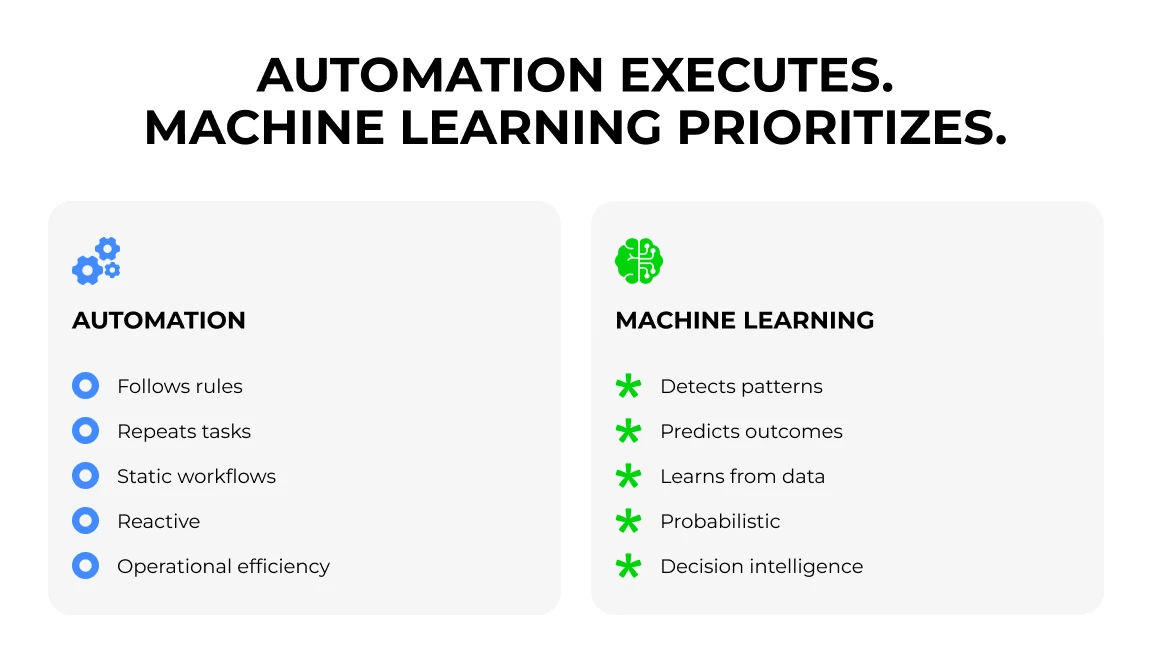
Automation follows defined rules. Machine learning identifies patterns, predicts probabilities, and improves decisions based on data.
What are practical brand use cases for machine learning?
Audience segmentation, propensity scoring, churn prediction, content recommendation, and account prioritization are practical starting points.
What has to be in place first?
Clean first party data, clear business objectives, and governance for evaluation and action need to exist before models can create reliable value.
What This Unlocks Next
The next growth constraint is rarely isolated. Once this issue is addressed, the next question is how to strengthen the next layer of the brand, authority, revenue, and execution system.
Read the next article in the Forward Thinkers series: Trust Signals Are the New Conversion Infrastructure