
Brand Authority in the Age of AI Search


Authority used to be treated as a reputation asset. A company had a polished website, a capable founder, a few references, and maybe a conference presence, and leadership assumed the market would connect the dots. That assumption no longer holds. Today the market learns about you through search results, AI generated summaries, social snippets, third party reviews, case studies, analyst commentary, and the connective tissue across your site. If those signals are thin, inconsistent, or generic, the market does not infer expertise. It infers sameness.
Google continues to tell site owners that content should be created to help people, show expertise, and provide a strong page experience. That matters because search visibility now depends less on publishing volume and more on whether a page clearly answers a question with trustworthy signals. In parallel, buyers are increasingly validating vendors before they ever request a call. Forrester reported in 2025 that 68 percent of B2B buyers already have a front runner at the start of the purchasing process and that front runner wins 80 percent of the time. The implication is direct. Authority is not what happens after awareness. Authority shapes who even makes the shortlist.
Why authority is now an operating issue
This is why brand authority has become an operating issue. If brand, sales, customer experience, and leadership all describe value differently, the market sees noise instead of confidence. If your proof sits in isolated decks, buried proposals, and tribal knowledge, search systems cannot interpret it and buyers cannot verify it. If your site has content but no evidence architecture, AI tools may summarize the wrong message because the strongest signals on the page are not the most credible ones. The cost shows up as lower conversion rates, longer sales cycles, and pressure to compensate through paid media or discounting.
What real authority looks like in practice
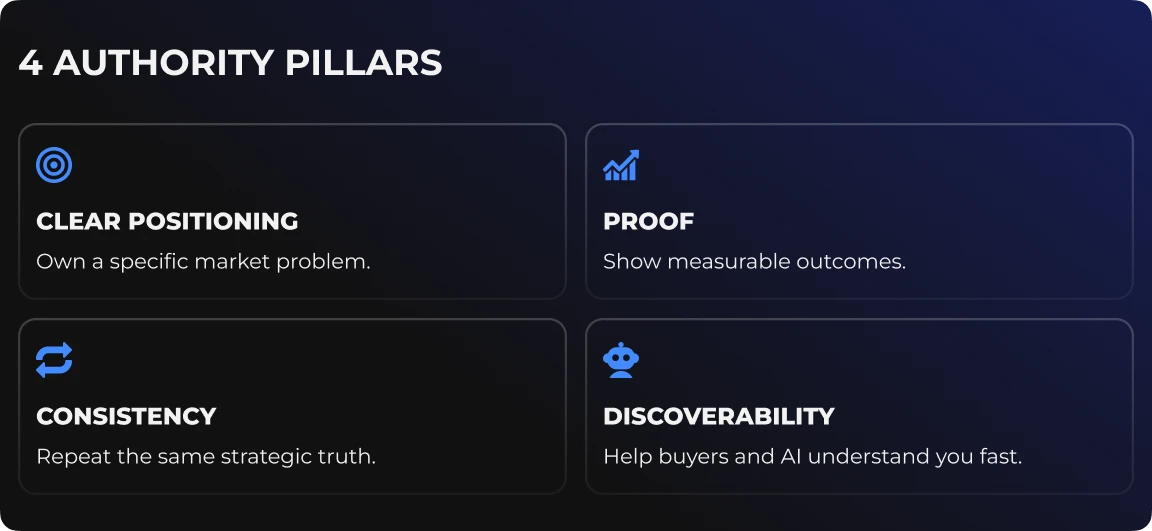
Real authority has four visible dimensions. First, it has a sharp point of view. Second, it has proof tied to outcomes, not just claims tied to adjectives. Third, it repeats the same strategic truth across pages, channels, and conversations. Fourth, it aligns expertise with the questions buyers actually ask. That means a consulting firm should not only say it helps clients grow. It should show how it diagnoses growth constraints, what commercial tensions it resolves, and what measurable improvements occur when execution aligns. The more specific the market problem, the easier it is for authority to accumulate.
How AI discovery changes buyer validation
AI changes the stakes because it compresses discovery. A buyer can ask a system to compare firms, summarize a category, identify implementation risks, or surface likely options before speaking to any vendor. If your digital footprint is shallow, the model still produces an answer, just not one that works in your favor. The fix is not gaming AI systems. The fix is strengthening the source material those systems can observe. That means deep service pages, expert articles, case based insight, visible leadership expertise, structured FAQs, and supporting references that reduce ambiguity.
How to build authority through proof and consistency
For leadership teams, the most practical move is to build an authority map. Start with the commercial issues you want to own in market. Identify the pages, articles, proof points, and leader perspectives that should support those issues. Then test whether every asset answers a buyer question, contains a credible evidence signal, and moves the reader toward the next logical action. This is where AI automation can help. It can cluster recurring customer questions, surface topic gaps across your site, identify weak internal links, and help teams repurpose research into multiple usable formats. What it cannot do is invent authority where the company has not developed one.
What to measure next
The measurement model also needs to mature. Authority should not be judged only by vanity engagement. Watch branded search volume, qualified organic visits, time on high intent pages, assisted conversions, and how often sales hears that a buyer already understands your perspective before the first meeting. Those are stronger indicators that the market is developing preference, not just fleeting awareness. In advisory businesses especially, authority compounds when content, proof, and delivery all tell the same story.
The companies that win this transition will not be the ones publishing the most. They will be the ones publishing the clearest commercial intelligence with the strongest evidence trail. In an AI shaped discovery environment, the market rewards firms that are easy to understand, easy to trust, and easy to validate. That is what brand authority now means.
Practical Expansion
Consider how authority is built in the real world. A leadership team may believe it is known for strategic growth work, but if the website mostly describes services in broad language and the blog library mostly offers surface level marketing advice, the observable brand is not strategic. It is generic. The market does not judge expertise based on internal confidence. It judges expertise based on the evidence it can see quickly. That is why authority work often starts with content triage. Remove weak pages, strengthen cornerstone pages, and elevate the assets that prove the specific commercial problems you can solve.
A second mistake is confusing thought leadership with self expression. Strong authority content is not a stream of opinions detached from buyer needs. It is a disciplined body of insight that helps the reader make a better decision. That means naming tradeoffs, explaining implementation risk, and showing where leaders commonly waste money or time. The more the article helps a serious buyer reduce uncertainty, the more authority it creates. This is also why references matter. They signal that the company respects evidence and can connect its view to credible external research instead of asking the market to trust unsupported claims.
The leadership move is to establish a quarterly authority agenda. Pick the commercial themes the business wants to own, align executives around the claims that can be defended, assign proof gathering responsibility, and build one high quality asset at a time around those priorities. That operating rhythm is more valuable than random publishing because it compounds. Over time, the market begins to see the same sharp ideas, the same proof logic, and the same confidence across channels. That is how authority becomes durable enough to influence both search behavior and sales outcomes.
The operating payoff is strategic memory in public. When prospects repeatedly encounter the same well supported perspective across articles, service pages, and leadership commentary, they stop experiencing your company as a collection of services and start experiencing it as a credible authority. That shift lowers the burden on every later interaction because the market is no longer meeting you cold. It is meeting a body of evidence. In competitive categories where trust is expensive to earn, that compounding effect is one of the few advantages that keeps getting stronger as more quality content is added.
Execution Checklist
- Define three to five issues the company wants to own in market.
- Map proof assets to each issue, including case results and leader expertise.
- Upgrade high intent pages before publishing more low value content.
- Use AI tools to identify missing buyer questions and internal link gaps.
- Review assisted pipeline and sales feedback quarterly to confirm authority is compounding.
FAQ Section
What is brand authority in AI search?
It is the combination of positioning clarity, expert content, trust signals, and proof that helps both buyers and AI enabled discovery systems understand why your company is credible.
Does more content automatically increase authority?
No. Authority grows when content is differentiated, evidence based, and connected to the actual questions buyers ask before they purchase.
How can AI help strengthen authority?
AI can accelerate research, topic clustering, content operations, and internal linking analysis, but human expertise still has to define the point of view and validate the proof.