Most Growth Problems Are Misdiagnosed: Diagnose the Commercial System Before You Spend More


A commercial growth diagnosis separates visible symptoms from root constraints across market story, buyer conversion, sales execution, workflow, data, and management cadence. The purpose is to identify the highest impact constraint before leadership adds more spending, tools, or activity.
Growth Activity Is Not the Same as Growth Control
When revenue slows, the first instinct is often to add activity. Marketing launches another campaign. Sales increases outreach. Leadership introduces a new dashboard. Operations buys another tool. Those moves may create motion, but they do not prove that the business has identified the constraint. A company can work harder inside the same broken system and create more noise, more handoffs, and more cost without producing a better commercial outcome.
The better starting question is not what should we add. It is where does the system stop converting effort into measurable growth. That question changes the nature of the work. It moves the discussion away from departmental opinions and toward a connected diagnosis of the market story, buyer path, proof, website, sales process, CRM, workflow, ownership, and management routines. The visible symptom may sit in one function while the actual constraint sits somewhere else.
Why Leadership Teams Solve the Wrong Problem
Most organizations diagnose from the point of pain. If pipeline is weak, they assume marketing is the problem. If close rates are low, they assume sales needs training. If the team is overloaded, they assume headcount is the answer. Pain is useful evidence, but it is not a complete diagnosis. The same symptom can be created by different constraints, and the correct response depends on which constraint is active.
Weak pipeline may come from an unclear market position, poor search visibility, a website that does not guide the next decision, an offer that is too broad, or a sales response process that lets qualified demand decay. Low close rates may come from weak proof, unclear qualification, inconsistent proposals, poor stakeholder mapping, or no defined follow-up standard. Overload may come from avoidable work, unclear ownership, broken systems, or processes that were never redesigned as the company grew.
The Six Places Growth Friction Usually Hides
A useful diagnosis examines the commercial system as a sequence rather than a list of departments. The first layer is market story: whether the business can explain the problem it solves, for whom, and why the outcome matters. The second is customer decision: whether the website and supporting assets help a serious buyer understand, validate, and act. The third is integrated sales execution: whether every lead has a stage, owner, response standard, required proof, and next action.
The fourth layer is workflow: whether recurring work is documented, routed, and improved or still depends on tribal knowledge and manual rescue. The fifth is intelligence: whether data from marketing, sales, service, and operations can be trusted enough to guide decisions. The sixth is management cadence: whether leaders set demanded outcomes, assign ownership, review variance, remove friction, and convert learning into the next operating cycle. Growth weakens when one layer cannot support the next.
- Market story: The market does not understand the problem, value, or differentiation.
- Customer decision: The website and assets create interest but do not reduce risk or guide action.
- Sales execution: Leads move through inconsistent stages, handoffs, and follow-up.
- Workflow: Repeatable work remains manual, undocumented, or dependent on a few people.
- Intelligence: Data exists, but definitions, source quality, and decision use are weak.
- Management cadence: Priorities change without clear outcomes, owners, measures, or review.
A Diagnosis Should Produce a Decision, Not a Report
Many assessments fail because they produce observations without a decision. Leadership receives a long document, agrees that several issues exist, and then returns to the same operating rhythm. A useful commercial diagnosis should end with a constrained set of actions. Some issues must be fixed now because they are actively limiting revenue or customer trust. Some should be prepared next because the business is not ready to build them safely. Some should be monitored because evidence is incomplete. Some should be stopped because they consume resources without supporting the demanded outcome.
This discipline matters because growth teams are rarely short on ideas. They are short on sequencing. A good diagnosis converts complexity into an order of operations. It tells leadership which constraint has the greatest impact, which dependencies must be resolved first, which resources are required, and what evidence will show whether the intervention worked. That is more valuable than a broad recommendation to improve marketing, sales, technology, or alignment.
Why More Campaigns Often Make the System Harder to Fix
Campaigns are useful when the underlying system is ready to receive demand. They are expensive when the system is not. More traffic sent to a weak website creates more abandonment. More leads sent into an undefined sales process create more inconsistent follow-up. More content published without a clear authority architecture creates more pages competing for attention and internal links. More automation applied to an unstable workflow simply moves errors faster.
The commercial cost is not limited to wasted media. The business also creates false learning. Leaders may conclude that a channel, market, or offer does not work when the real issue was the conversion path, proof, response time, or operating handoff. A diagnosis protects the company from making strategic conclusions based on execution failure. It also creates a cleaner baseline so later investments can be measured against the right constraint.
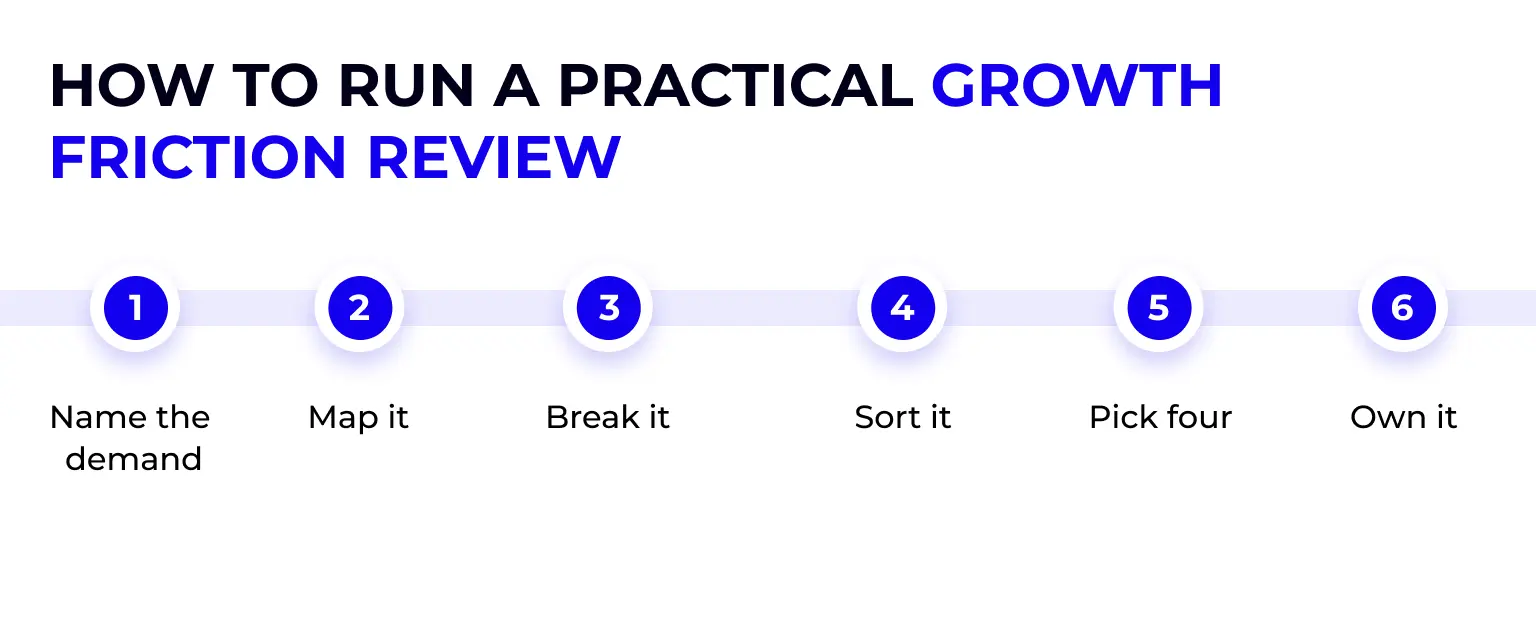
How to Run a Practical Growth Friction Review
Start with a demanded outcome stated in measurable business terms. It may be qualified pipeline, faster conversion, stronger retention, a new market launch, lower cost to serve, or more predictable execution. Then map the current path from market signal to measured result. Review the language the market sees, the pages and assets buyers use, the way inquiries enter the system, the stages and standards sales follows, the workflows teams rely on, and the management routines that govern progress.
Use both evidence and interviews. Analytics, CRM data, campaign performance, pipeline history, customer feedback, call notes, process documents, and financial results reveal different parts of the system. Leadership should also compare what the organization believes is happening with what the data and frontline teams can prove. The gap between stated process and actual behavior is often where the most important friction appears.
- Define one demanded outcome and the time frame in which it must move.
- Trace the buyer and work path from first signal through revenue and delivery.
- Identify where decisions stall, proof weakens, ownership blurs, or work becomes manual.
- Separate root constraints from secondary symptoms and unrelated improvement ideas.
- Prioritize one immediate fix, one preparation priority, one monitored risk, and one activity to stop.
- Assign owners, measures, and a review cadence before implementation begins.
The Leadership Standard Is Clarity Before Acceleration
Strong leadership is not measured by how quickly the company starts the next initiative. It is measured by whether the initiative addresses the real constraint and whether the organization can manage the change. Clarity before acceleration is not delay. It is protection against spending another quarter on activity that cannot compound.
The most valuable outcome of a growth diagnosis is a shared explanation of why performance is constrained and what must happen next. When leadership, marketing, sales, operations, and technology can see the same system, accountability improves. The business can stop treating each symptom as a separate emergency and start building a commercial system that makes growth visible, repeatable, and continuously improved.
What Leadership Should Expect After Diagnosis
A strong diagnosis does not promise that every constraint can be fixed at once. It creates a disciplined starting point and makes the tradeoffs visible. Leadership should leave with one primary constraint, a short list of enabling priorities, named owners, a baseline, and a sequence that protects the business from competing initiatives. This is also the point at which the organization decides what not to build. Stopping low-value activity can create as much capacity as adding a new capability.
The next phase should test the diagnosis through execution. If the intervention does not move the expected leading indicators, the team should revisit the assumption rather than defend the original recommendation. Diagnosis is not a one-time declaration. It is the beginning of a managed learning cycle that links evidence, action, and leadership decisions.
Frequently Asked Questions
What is a commercial growth diagnosis?
It is a structured review of the market story, buyer path, sales execution, workflows, data, and management cadence used to identify the root constraint slowing growth.
How is a growth diagnosis different from a marketing audit?
A marketing audit focuses primarily on marketing performance. A commercial growth diagnosis examines the full system that converts demand into revenue, delivery, and measurable results.
When should a company complete a growth diagnosis?
A diagnosis is useful when demand exists but pipeline, conversion, execution, or revenue visibility remains inconsistent and leadership cannot agree on the root cause.
What should the diagnosis produce?
It should produce a prioritized decision path with immediate fixes, preparation priorities, monitored risks, activities to stop, owners, measures, and a defined review cadence.
Explore the relevant Forward Thinkers path to Find your next move.