Consumer Reach Is Now a Systems Problem, Not Just a Media Problem


Companies often treat reach like a media variable. The assumption is simple. If impressions are flat, increase spend or add channels. That was always incomplete, and it is even less true now. Reach is shaped by whether your business can be found, understood, trusted, remembered, and reengaged across a fragmented path of discovery. Media plays a role, but it is only one part of the system.
Today a prospect might discover a company through search, a social clip, a referral, an AI summary, a trade article, a newsletter mention, or a repurposed podcast insight that surfaces months after it was recorded. They may then evaluate through review sites, service pages, thought leadership, pricing cues, and case based proof. Think with Google describes this decision process as a messy middle of exploration and evaluation. The implication for growth leaders is that reach no longer starts and ends with campaign distribution. Reach is the cumulative effect of all the assets and signals that help a buyer encounter the brand in useful context.
Why reach has become more fragmented
Inside most organizations, reach breaks because the system is fragmented. The paid team optimizes to clicks. The content team writes without a distribution plan. The website is not mapped to buying stages. CRM data is underused. Sales questions are not informing editorial priorities. Product or service changes never reach the site architecture. As a result, the company has activity without compounding. Each channel works in bursts instead of reinforcing the others.
What breaks reach inside growing companies
A systems view changes the question from How do we get more views to How do we create more qualified points of entry into the business. That leads to better decisions. Search content is built around recurring commercial questions. Organic social is used to extend authority and direct traffic to owned assets. Email is aligned to lifecycle moments. Paid media supports pages with clear conversion paths rather than weak generic landing pages. CRM tagging informs retargeting and editorial priorities. Customer service insight identifies content gaps that should have been resolved earlier in the journey.
How systems thinking improves discoverability
This is where AI automation becomes materially useful. It can summarize call transcripts to reveal emerging buyer questions. It can classify leads by source quality and content touchpoints. It can help teams repurpose one substantial insight into multiple distribution formats without reinventing the idea each time. It can identify broken internal links, weak metadata, and pages with poor semantic coverage.
Databricks reported in its 2026 State of AI Agents study that enterprises are increasingly using AI to automate routine tasks and that 40 percent of leading AI use cases center on customer experience and engagement. That pattern supports a practical point. The best early AI applications are often the ones that strengthen the system around customer reach, not the ones that chase novelty.
Where AI automation expands useful reach
Consumer reach also depends on trust architecture. A company may technically appear in many places yet still fail to convert because none of the assets reduce perceived risk. Reach without trust creates attention but not movement. That is why category clarity, message consistency, proof, and friction reduction matter so much. If the first touchpoint creates interest but the next touchpoint creates doubt, the system breaks even if top of funnel metrics look healthy.
What leaders should build first
For leadership, the operating move is to build a reach map. Identify the major channels where your audience explores and evaluates. Define the role each channel should play. Map the supporting assets required to move a buyer to the next step. Then assess where the system is thin, disconnected, or duplicative. Most companies discover they do not need more channels. They need better orchestration and stronger asset quality in the channels they already use.
Reach is no longer bought only through media. It is built through connected systems that help the right people find you, recognize your value, and continue the journey without losing confidence. The companies that understand that will create more durable growth because their reach compounds instead of resetting every campaign cycle.
Practical Expansion
A systems view of reach also changes how content gets funded. Instead of treating articles, landing pages, email flows, and paid assets as separate line items, leadership can evaluate whether they are creating a stronger network of entry points into the business. One article might never produce a direct conversion but still become valuable because it supports internal linking, trains AI discovery systems on the firm’s language, equips sales with a stronger educational asset, and increases return visits from a qualified segment. That is a better way to think about reach than judging every touchpoint in isolation.
The same logic applies to channel conflict. Many teams argue over which channel deserves credit when the better question is whether the channels are making each other stronger. Search may capture demand that social first stimulated. Email may convert demand that organic search first educated. A podcast clip may influence a buying group long before a tracked site visit occurs. Systems thinking encourages leaders to ask whether the entire environment makes the company easier to encounter and easier to understand. That is closer to how buyers behave in reality than narrow attribution arguments suggest.
For execution, create a reach operations review every month. Bring together media, content, CRM, web, and sales perspectives. Review where qualified visitors entered, what assets they touched, where journeys stalled, and what questions remained unresolved. That process turns reach from a channel scoreboard into a coordinated operating discipline. It also creates better feedback for AI systems because the organization is working from a shared understanding of where discovery and evaluation actually succeed or fail.
Teams that solve reach systemically also become harder to outcompete. A competitor can outspend you for a period, but it is much harder for them to recreate a network of useful articles, trusted proof pages, responsive email flows, aligned CRM triggers, and content informed by frontline customer questions. That integrated structure becomes an advantage because it improves not only acquisition, but also learning speed. The business hears the market faster, updates assets faster, and keeps making itself easier to discover and easier to choose.
In practice, this means consumer reach planning should be reviewed with the same rigor as pipeline planning. Leaders should know which assets create first discovery, which assets build evaluation confidence, and which assets convert intent into action. If that chain is weak, increasing media budget usually creates diminishing returns because the system is asking media to solve for problems in content, website structure, or lifecycle design. Better systems turn every channel into a multiplier for the others instead of a standalone cost center.
Execution Checklist
- Map the top five discovery channels and define each channel’s job.
- Identify the supporting assets needed at exploration and evaluation stages.
- Use CRM and sales notes to find the questions the current system is not answering.
- Strengthen internal links so discovery assets lead into proof and conversion assets.
- Review qualified entry points monthly instead of judging channels only by last touch results.
Leader Questions to Pressure Test the Strategy
- Do our channels currently reinforce one another or compete for attention without a shared path?
- Where do qualified buyers first discover us, and what do they see next?
- Which parts of the journey answer questions well, and which parts force buyers back into confusion?
A reach system improves when these questions are reviewed regularly instead of being left to isolated channel teams.
FAQ Section
Why is consumer reach a systems problem?
Because buyers move across search, social, AI discovery, email, referrals, and websites. Reach depends on how well those channels connect and reinforce each other.
What usually breaks reach?
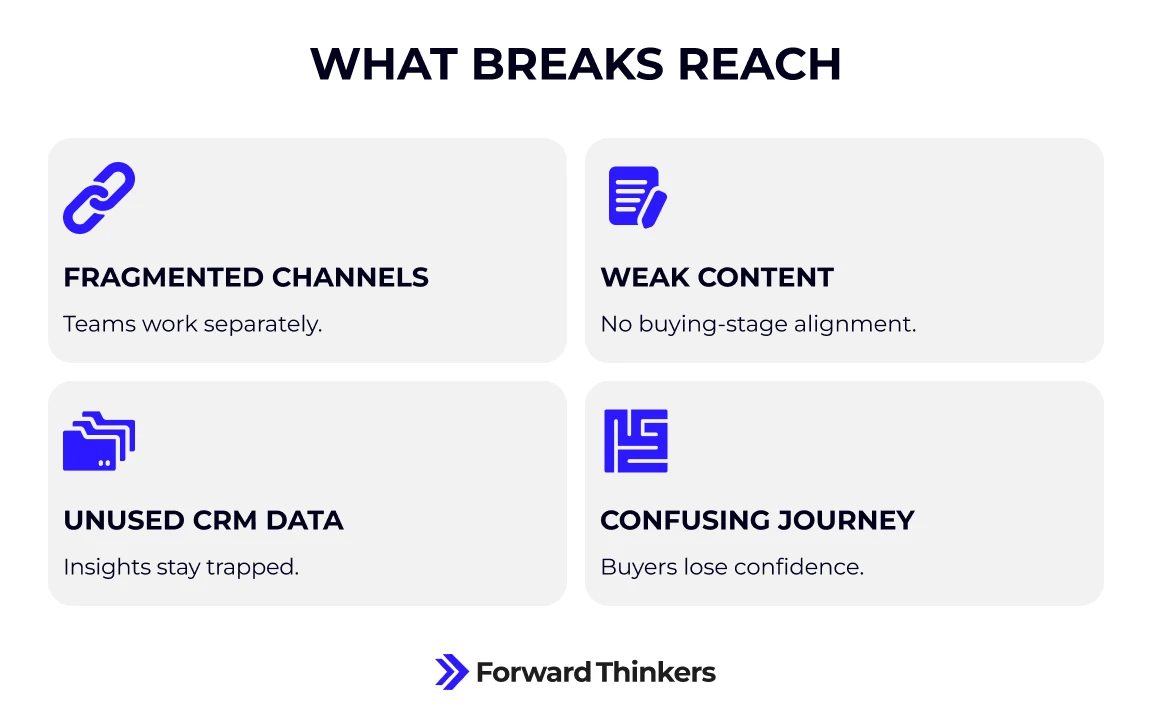
Disconnected channel teams, weak site architecture, poor use of CRM insight, and content that is not mapped to buying stages are common failure points.
Where can AI improve reach?
AI can improve reach by surfacing customer questions, speeding repurposing, improving distribution planning, and strengthening lifecycle orchestration.
What This Unlocks Next
The next growth constraint is rarely isolated. Once this issue is addressed, the next question is how to strengthen the next layer of the brand, authority, revenue, and execution system.
Read the next article in the Forward Thinkers series: First Party Data Is the New Brand Intelligence Layer
If this article reflects the challenge your organization is facing, engage Forward Thinkers to assess the strategic, operational, digital, and revenue constraints that are limiting growth.