
Capacity Is a Leadership Blind Spot


One of the most common leadership mistakes is assuming commitment can overcome capacity.
It can’t.
When leaders ignore capacity, execution slows, frustration rises, and trust erodes. What looks like resistance is often overload.
Capacity Is Not Effort
Capacity is not about how hard people work. It’s about how much demand is placed on them relative to the time, tools, and resources available.
People cannot:
- Do the work
- Lead the work
- Change the work
all at the same time without support.
A Lesson from the Field
Early in my career, while walking stores with a Fortune 100 CEO, we were pushing aggressively to grow average basket size. The strategy was sound. The execution struggled.
His insight stayed with me.
A buyer’s idea may be easy to understand. That does not mean it is easy to execute.
Without understanding total demand against real capacity, even aligned initiatives fall short.
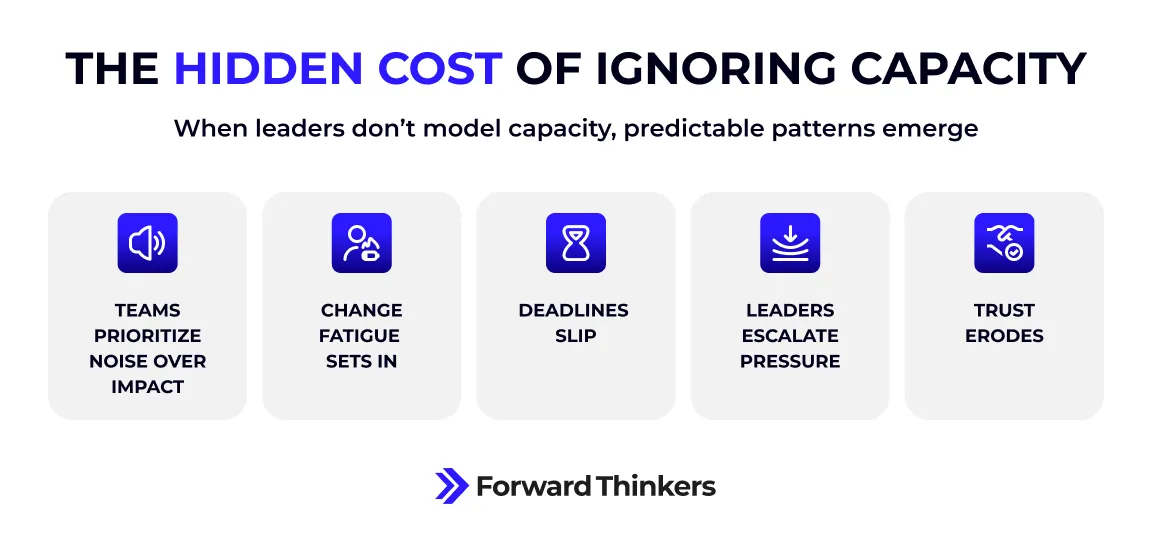
The Hidden Cost of Ignoring Capacity
When leaders fail to model capacity:
- Teams prioritize what’s loudest, not what matters
- Change fatigue sets in
- Deadlines slip
- Leaders escalate pressure
- Trust erodes
None of this is intentional. It’s structural.
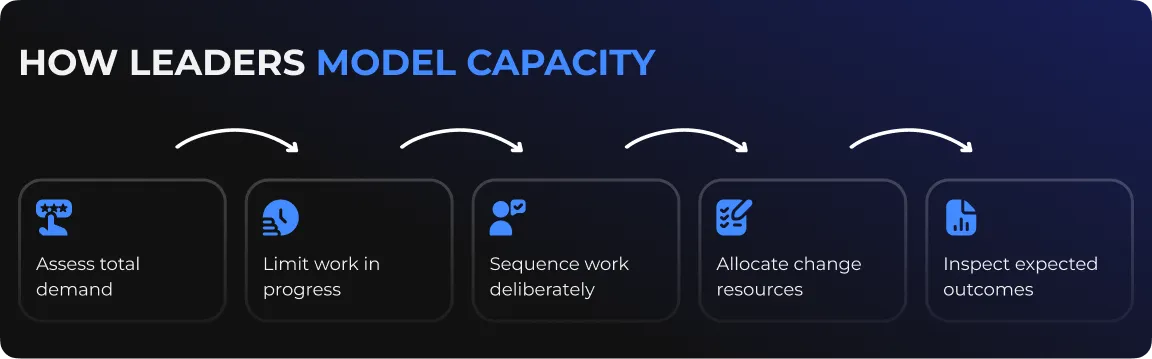
How Leaders Model Capacity
Effective leaders:
- Inventory total demand, not just priorities
- Limit initiatives in flight
- Sequence work intentionally
- Provide dedicated change resources when possible
- Inspect what they expect
Capacity modeling is not optional. It is leadership.
If initiatives keep stalling, the issue may not be alignment or effort. It may be capacity.
Forward Thinkers helps leaders model demand, sequence work, and restore execution momentum.