Brand Led Revenue Operations for Sustainable Growth


Revenue operations is often framed as a systems and process discipline. Dashboards are cleaned up, handoffs are mapped, lifecycle stages are standardized, and leaders hope efficiency will follow. Those actions matter, but many organizations still underperform because the revenue system is missing a critical strategic layer: Brand.
We are not talking about brand merely as visuals or awareness. We are talking about brand as the organizing logic that tells the market what the company means, what it promises, and why that promise should be believed. Without that layer, rev ops can optimize movement through a funnel that was never strategically coherent to begin with.
The Missing Strategic Layer in Revenue Operations
Brand-led revenue operations starts from the premise that growth quality improves when messaging, targeting, sales narratives, customer experience, and proof are flawlessly aligned.
If marketing generates demand from a vague promise, sales inherits weak expectations. If sales tells a different story than the website, customer success inherits trust debt. If service delivery solves a more specific problem than the brand claims in the market, the company hides its true differentiator.
Rev ops may see symptoms such as low conversion rates, extended sales cycles, or high churn, but the root cause is often strategic misalignment disguised as process friction.
Why Brand Belongs in the Revenue Conversation
Positioning determines who should be attracted. Message architecture determines what expectations are set. Trust signals influence whether prospects advance. Service clarity influences whether sales can qualify properly. Proof infrastructure affects how quickly buying groups gain confidence.
Brand, therefore, directly shapes the quality of leads, the efficiency of sales, and the likelihood of retention. It is not upstream from revenue operations—it is embedded entirely within it.
The Five Layers of a Brand-Led Rev Ops Model
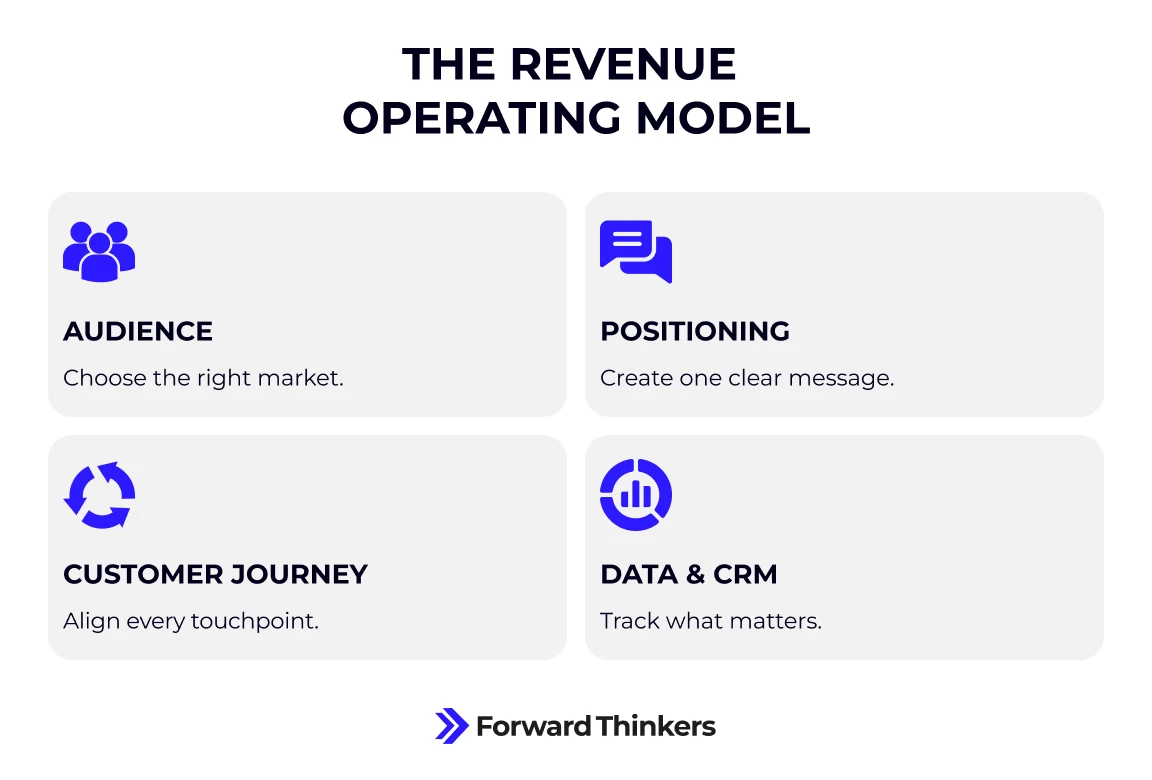
A practical brand-led rev ops model connects five distinct layers. When these layers reinforce one another, the organization can identify where growth is constrained and fix the right problem faster.
- Audience and Market Choice: Defining exactly who the brand serves and who it does not.
- Positioning and Message Architecture: Structuring the promises and claims made to that audience.
- Journey Design: Mapping the experience across content, campaigns, sales conversations, and service touchpoints.
- Data and Process: Establishing CRM structure, lifecycle stages, attribution logic, and handoff rules.
- Feedback Loops: Capturing win/loss insights, retention data, service themes, and expansion signals.
How AI and Data Sharpen Execution
AI and machine learning strengthen this model when used to improve signal flow and operating speed. AI can classify inbound questions, summarize sales conversations, route requests intelligently, recommend the next content asset, and surface recurring friction points from service data. Machine learning can improve lead scoring, identify conversion patterns, and predict expansion or churn risks.
However, value only comes when these tools are integrated into governed workflows. Tools alone do not create sustainable growth. Disciplined execution does.
Diagnosing Growth Friction
Brand-led revenue operations give leadership a better way to diagnose where growth is breaking.
If lead volume is strong but close rates are weak, the issue may not be sales productivity. It may be positioning attracting the wrong audience, or trust signals failing to support the evaluation stage. If retention is soft, the issue may not be onboarding. It may be expectations created by marketing that the delivery team never intended to set.
This systems lens helps executives stop solving symptoms in isolation and start fixing the strategic misalignments that keep reproducing those symptoms.
The Path to Sustainable Growth
Sustainable growth is not merely growth that lasts. It is growth that can be repeated without forcing the business to overspend, overpromise, or exhaust the team. That requires better alignment between what the market hears and what the organization can actually deliver.
Rev ops is the mechanism that should make that alignment visible and manageable. Brand is the strategic signal that tells rev ops what it is supposed to optimize for in the first place. If your business is chasing growth but experiencing friction across demand, sales, and delivery, resist the urge to look only at funnel mechanics. Look at the story, the proof, the targeting, and the expectations being created across the journey.
When brand and revenue operations move together, growth becomes cleaner, more trusted, and more durable.
Execution Checklist
- Align the foundation: Align positioning, proof, and target audience before revising funnel stages.
- Map the gaps: Identify where expectations shift inconsistently between marketing, sales, and service.
- Leverage data: Use CRM, service, and win/loss insights to find recurring friction points.
- Automate responsibly: Automate routing and summarization only after process and ownership are explicitly clear.
- Review holistically: Review growth performance as an interconnected system, not as isolated departmental metrics.
Frequently Asked Questions
What is brand-led revenue operations?
It is a growth model that aligns positioning, messaging, demand generation, sales, service, and data systems so the company grows with less friction and stronger commercial consistency.
Why does brand belong inside rev ops?
Because brand shapes the quality of demand, the expectations sales inherits, and the trust that directly affects conversion and retention.
Where do AI and machine learning fit into this model?
They fit in routing, summarization, pattern detection, scoring, and workflow acceleration. However, they require clear governance and business logic to create durable value.
If this article reflects the challenge your organization is facing, engage Forward Thinkers to assess the strategic, operational, digital, and revenue constraints that are limiting your growth. Contact Us for a Strategy Advisory Session