
Brand Governance for Scale, How to Grow Without Fragmenting the Story


Why growth creates governance risk
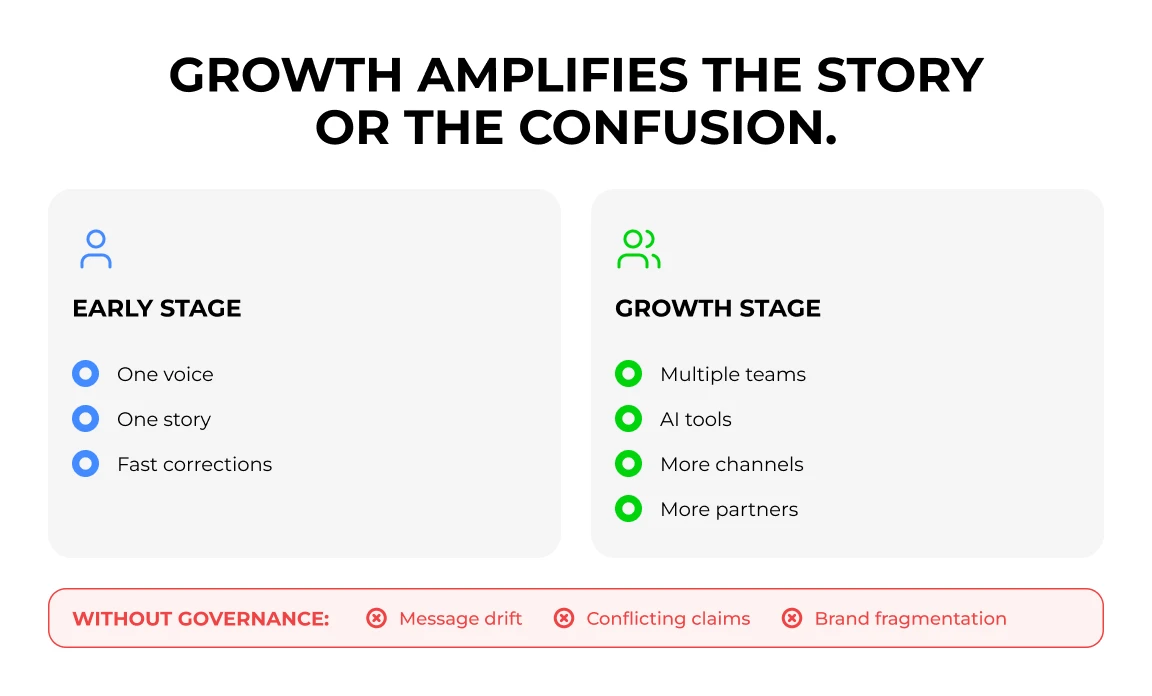
Growth usually starts by concentrating power. A founder or tight leadership group shapes the story, approves major assets, and stays close enough to the market that inconsistencies get corrected quickly. Success changes that. More people create content. More agencies contribute. More service lines want visibility. More automation enters the process. Without governance, the story fragments precisely when the company is becoming more visible.
That fragmentation is rarely dramatic at first. It shows up as small deviations. A new campaign uses broader claims than the website can support. A sales deck introduces category language the delivery team does not use. An AI drafting workflow pulls stale messaging from old files. Regional teams personalize beyond the point of consistency. Over time the market sees a company with multiple voices, multiple promises, and no clear center. Scale becomes expensive because every asset now needs more correction or produces more confusion.
What governance really covers
Brand governance is the answer, but many companies misunderstand what that means. Governance is not just a style guide or a logo file. It is the operating model that determines what can be said, how proof should be used, who approves what, what sources are allowed, what claims require legal or leadership review, how pages are refreshed, how AI tools are used, and how exceptions are managed. In other words, governance protects the integrity of the story while allowing the organization to move at a useful pace.
How AI raises the importance of standards
This has become far more important in an AI enabled environment. AI can accelerate asset creation, but speed without controls can quickly multiply bad inputs. Databricks found that organizations using AI governance and evaluation are dramatically more likely to move AI work into production successfully. The brand equivalent is obvious. If a company wants to use AI across content, personalization, internal knowledge, and workflow automation, it needs rules for source quality, approval, version control, and claims management. Otherwise automation just spreads inconsistency faster.
What a practical governance model looks like
A practical governance model has five elements:
- A clearly defined messaging hierarchy, including approved positioning, pillars, and proof standards.
- Ownership for strategic updates so teams know who can change the story and who can only adapt it.
- Review thresholds, meaning not every asset needs executive review, but certain claims, offers, and strategic pages do.
- Workflow documentation for content, design, web, and AI use.
- An audit cadence to identify drift before it becomes visible in market performance.
Governance should also support commercial alignment, not slow it down. Good governance makes execution easier because teams do not have to reinvent the message every time they launch something new. It reduces debates, speeds approvals, and creates confidence that a new page or campaign is building equity rather than borrowing against it. It also improves onboarding because new employees learn the language system quickly and can contribute with fewer corrections.
What leaders should monitor
Leaders should monitor brand governance through symptoms, not just compliance checklists. Watch for rising message inconsistency across assets, repeated buyer confusion, proposal language that drifts from the site, and channels that overpromise relative to delivery. Watch whether internal teams can explain the company the same way. Watch whether AI generated drafts require heavy correction because the source system is messy. Those are indicators that governance is either missing or too weak to matter.
Companies that scale well do not protect brand clarity by moving slowly. They protect it by building systems that let many people move in the same direction. That is what governance is really for. It turns brand from a collection of assets into a managed operating discipline, which is exactly what growth requires.
Practical Expansion
Governance also protects institutional memory. As organizations scale, people change roles, new vendors enter, and AI systems are trained on existing assets. If the source environment is inconsistent, every new contributor inherits confusion. A strong governance model captures the current truth of the brand in a way that survives turnover and operational change. That is particularly valuable in founder led businesses where much of the strongest strategic language initially lives in the founder’s head. Governance turns that tacit knowledge into an asset the organization can actually use and defend.
Good governance is also adaptive. It does not freeze the brand. It creates a process for change. New proof can be added. Positioning can evolve. Pages can be refreshed. AI prompts can be improved. What matters is that these changes happen through an agreed system instead of through accidental drift. This distinction becomes more important as companies use more automation, because the faster assets are produced, the more important it is to know which version of the truth is supposed to guide them.
The leadership move is to create a governance council with clear but limited scope. It should own message integrity, proof standards, and review rules for strategic assets. It should also review where the market is showing confusion so governance can solve real business problems instead of becoming a compliance ritual. When done well, governance is one of the quietest but highest value growth enablers in the company.
Over time, governance should also influence how success is measured. Instead of only asking whether an asset launched on time, leadership should ask whether the asset strengthened clarity, protected proof quality, and matched the strategic narrative the business is trying to build. That reframes governance from control for its own sake into a mechanism for commercial quality. When teams see that relationship clearly, governance becomes easier to adopt because it is visibly helping growth rather than merely policing language.
A useful governance test is whether a new contributor can create a strong first draft quickly without guessing at the company’s meaning. If they cannot, the problem is not the contributor. It is that the governance system has not translated strategic truth into usable operating standards. Strong governance reduces ambiguity for creators and reviewers alike. That reduction in ambiguity is one reason it becomes more valuable, not less, as growth accelerates.
Governance should also include a refresh mechanism for proof. Outdated testimonials, stale capability claims, and old case examples weaken credibility even when the core positioning is still correct. A governance system that audits proof currency along with message consistency helps the market see a company that is not only aligned, but current. That freshness matters for both buyer trust and AI interpretation because repeated, recent signals usually carry more practical weight than old unsupported claims. That simple discipline protects equity and decision quality over time.
Execution Checklist
- Document approved positioning, proof rules, and review thresholds.
- Assign owners for strategic updates and owners for routine adaptations.
- Create a source library for AI and human creators to work from.
- Audit a sample of market facing assets each month for drift.
- Use buyer confusion and conversion friction as signals for governance updates.
Leader Questions to Pressure Test the Strategy
- Who currently has authority to change strategic language?
- Which assets require escalated review and which do not?
- Can a new employee or partner produce something accurate without guessing?
Governance becomes much easier to strengthen when leadership can answer these questions clearly and document the answers in one place.
FAQ Section
What is brand governance?
It is the system of standards, ownership, approvals, and workflows that keeps brand messaging and proof consistent as the business grows.
Why does governance matter more with AI?
Because AI can accelerate production, but without standards it can also spread inconsistency and weak claims at scale.
Does governance slow teams down?
Good governance usually speeds execution because teams know the rules, the approved language, and the escalation points before work begins.
If this article reflects the challenge your organization is facing, engage Forward Thinkers to assess the strategic, operational, digital, and revenue constraints that are limiting growth. Contact Us / Executive Advisory
