AI Automation for Content Operations


AI has created a dangerous illusion inside many marketing teams. Because it can produce text quickly, leaders assume it can solve content bottlenecks directly. The result is predictable. Teams publish faster, quality falls, pages sound generic, and the brand becomes less memorable exactly when it needs stronger authority. The real opportunity is not using AI to replace expertise. The opportunity is using AI to improve the operating system around expertise.
Content operations usually break in mundane places. Research takes too long. Stakeholder interviews are not converted into usable assets. One good insight never gets repurposed into multiple formats. Editorial calendars drift from sales priorities. Internal links are weak. Metadata is inconsistent. Briefs are vague. Review cycles are bloated. None of those problems requires AI generated filler. They require better workflow design. That is where automation becomes valuable.
Why most teams misuse AI in content
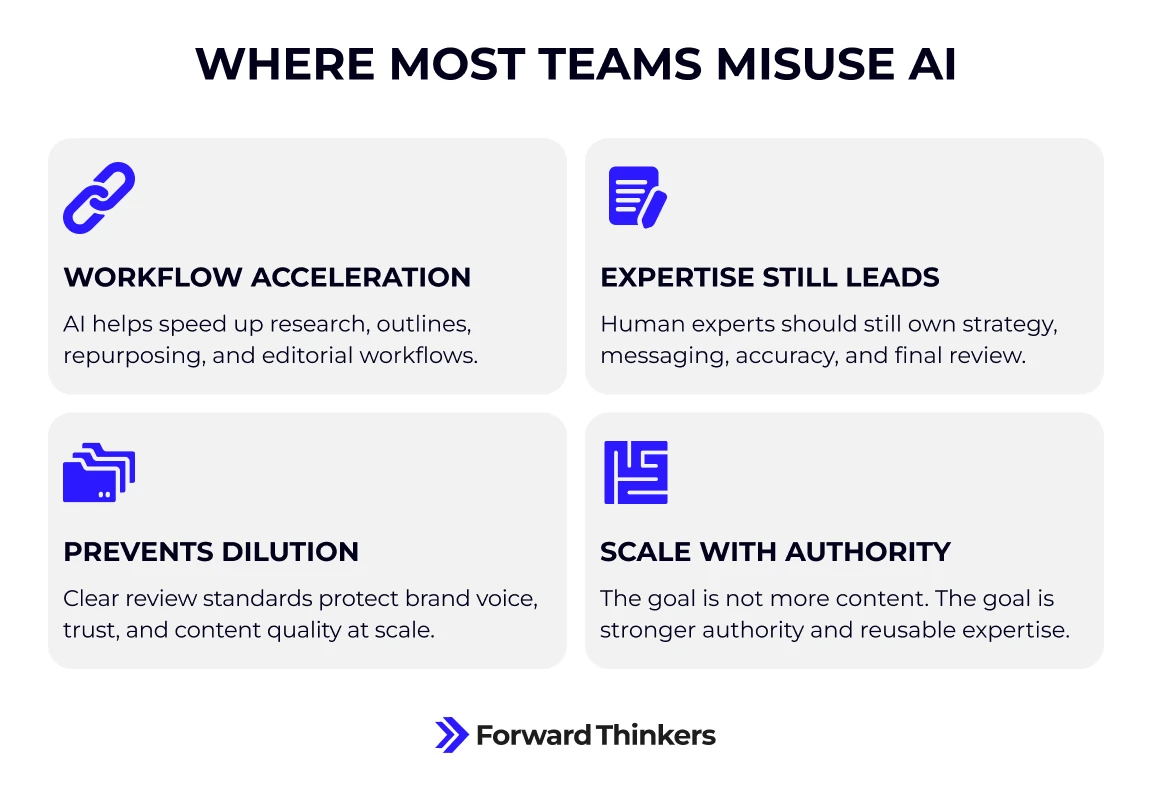
A strong AI content operating model divides work into three layers. The first layer is strategic judgment. This includes topic selection, thesis definition, audience priority, message discipline, and source standards. Humans should own this. The second layer is workflow acceleration. This includes transcript summarization, topic clustering, draft structuring, FAQ extraction, cross channel repurposing, internal link suggestions, and SEO support. AI can help heavily here. The third layer is validation and polish. Humans should confirm accuracy, relevance, voice, and commercial fit before anything goes live.
This structure matters because expertise is rarely contained in one perfect draft. Expertise often lives in calls, founder notes, case work, proposals, strategy sessions, and delivery insight. AI is useful because it can help capture and reorganize those assets quickly. A single recorded discussion can become an article outline, social post concepts, sales talk tracks, FAQ entries, and internal knowledge notes. That is real leverage. It expands the usable shelf life of expert knowledge without asking the team to recreate the idea from scratch each time.
Where automation adds real operating leverage
The latest enterprise AI data reinforces this operating view. McKinsey has reported that many organizations use AI widely but still struggle to embed it deeply enough into workflows to capture enterprise value. Databricks similarly shows that organizations are getting more AI into production when they invest in governance and evaluation. The lesson for content leaders is straightforward. AI only becomes an advantage when it is tied to repeatable processes, quality controls, and outcome measurement. Otherwise it becomes a volume engine disconnected from brand value.
What should automation handle in practice? It should prepare research summaries, identify recurring audience questions, classify themes from CRM and support logs, recommend internal link opportunities, generate first pass schema questions, and help convert one long form article into email, social, and sales follow up assets. What should it not control by itself? It should not set the market position, make unsupported claims, define the brand point of view, or publish without human review on topics tied to trust, expertise, and commercial advice.
How to design an expert led workflow
Governance matters because content is now part of brand infrastructure. Google continues to reward helpful, reliable, people first content, not pages built for manipulation or empty ranking plays. If AI generated output is shallow, repetitive, or unverified, it can weaken both user trust and search performance. That is why every expert led content system needs source rules, review ownership, publishing criteria, and refresh standards. The goal is not merely to publish more. The goal is to create a body of work that compounds into authority and pipeline.
What governance prevents dilution
The best measurement model goes beyond output volume. Watch how quickly expert input gets converted into publishable assets. Track how often content assists qualified pipeline, shortens sales education, or improves engagement on high intent pages. Measure reuse, not just production. The most efficient content function is not the one that writes the most pieces. It is the one that extracts the most commercial value from real expertise.
What to measure beyond volume
Used correctly, AI automation does not flatten your brand voice. It protects it by making the right work easier to execute. When workflow improves, experts spend more time shaping the message and less time wrestling with administrative friction. That is the kind of leverage that scales without dilution.
Practical Expansion
Another advantage of AI enabled content operations is that it improves editorial discipline when managed well. Teams can build reusable briefing structures, standardize FAQ extraction, and maintain reference libraries that make each new article better instead of starting from zero. This matters because expertise driven brands usually lose more value from inconsistency than from low output. A repeatable system lets the organization protect tone, proof, and quality even as contributors, formats, and channels expand. In that sense, workflow quality becomes part of brand quality.
The strongest examples usually come from companies that think like publishers and operators at the same time. They do not ask AI to invent the message. They use AI to reduce waste between idea and publication. They extract knowledge from leaders, normalize the structure, connect articles to service pages, build repurposing plans before drafting begins, and keep performance feedback attached to the content system. This operating mindset is much more defensible than simply asking for more posts each month because it creates reusable value rather than disposable volume.
A smart leadership move is to set publishing criteria that every draft must pass before it can go live:
- Does the article answer a real commercial question?
- Does it include proof or an evidence trail?
- Does it connect to an owned service or strategic page?
- Does it contain a credible CTA?
- Is the tone recognizably ours?
AI should make it easier to meet those standards, not easier to bypass them. When that standard exists, the content system becomes an asset rather than an output factory.
There is also a resourcing implication. Many companies think they need a larger content team when what they really need is a better operating model for the expertise they already possess. A partner, founder, or subject matter expert may produce enormous commercial value in one live discussion, but that value is lost if no system exists to capture and convert it. AI supported workflows make those moments more extractable. Instead of hiring more people to create more generic material, the company can invest in turning real expertise into a scalable editorial asset.
Companies that adopt this model well usually document their workflow in plain language. They define where ideas come from, how evidence is gathered, how drafts are structured, what review standards apply, and how performance feedback enters the next cycle. That documentation may feel operational, but it is actually strategic because it determines whether the brand’s best thinking becomes a compounding asset or disappears after each meeting, webinar, or client conversation.
Execution Checklist
- Separate strategy ownership from workflow acceleration tasks.
- Create standard prompts and review criteria tied to brand voice and proof.
- Repurpose every major insight into multiple usable formats before publishing.
- Connect every article to a service page and a commercial next step.
- Track assisted pipeline and asset reuse, not only total post count.
Leader Questions to Pressure Test the Strategy
- Where does real expertise currently get trapped in the organization?
- How long does it take for a meaningful conversation or case insight to become a publishable asset?
- Which review steps improve quality and which merely add delay?
Answering those questions usually exposes why content operations feel heavy even when the team is working hard.
FAQ Section
Can AI write all of a company’s content?
It can generate drafts, but expert led companies should keep humans responsible for thesis, validation, and final quality.
Where does AI help most in content operations?
It helps most in research synthesis, topic clustering, repurposing, internal linking analysis, and workflow acceleration.
How do you prevent brand dilution?
Use editorial governance, source rules, human review, and clear ownership of strategy and final publication.
What This Unlocks Next
The next growth constraint is rarely isolated. Once this issue is addressed, the next question is how to strengthen the next layer of the brand, authority, revenue, and execution system.
Read the next article in the Forward Thinkers series: Machine Learning for Better Brand Decisions, From Pattern Detection to Revenue Action
Ready to take the next step? Fill out our contact form and let's get to work.