
What a 120-Day Growth Path Must Include to Move From Diagnosis to Execution


A strategy document does not create movement
Leadership teams often leave strategic work with more clarity but no operating change. The findings may be accurate, the recommendations may be thoughtful, and the presentation may be persuasive. Yet the business returns to the same meetings, the same competing priorities, and the same unclear ownership. The gap is not strategy quality. The gap is conversion from diagnosis into an executable operating path.
A 120-day horizon is useful because it is long enough to build meaningful capability and short enough to force prioritization. It does not promise that every growth constraint will be solved in four months. It creates a disciplined period in which leadership can stabilize the most important friction, build the next system layer, measure early movement, and decide what should scale next.
Start with one demanded outcome
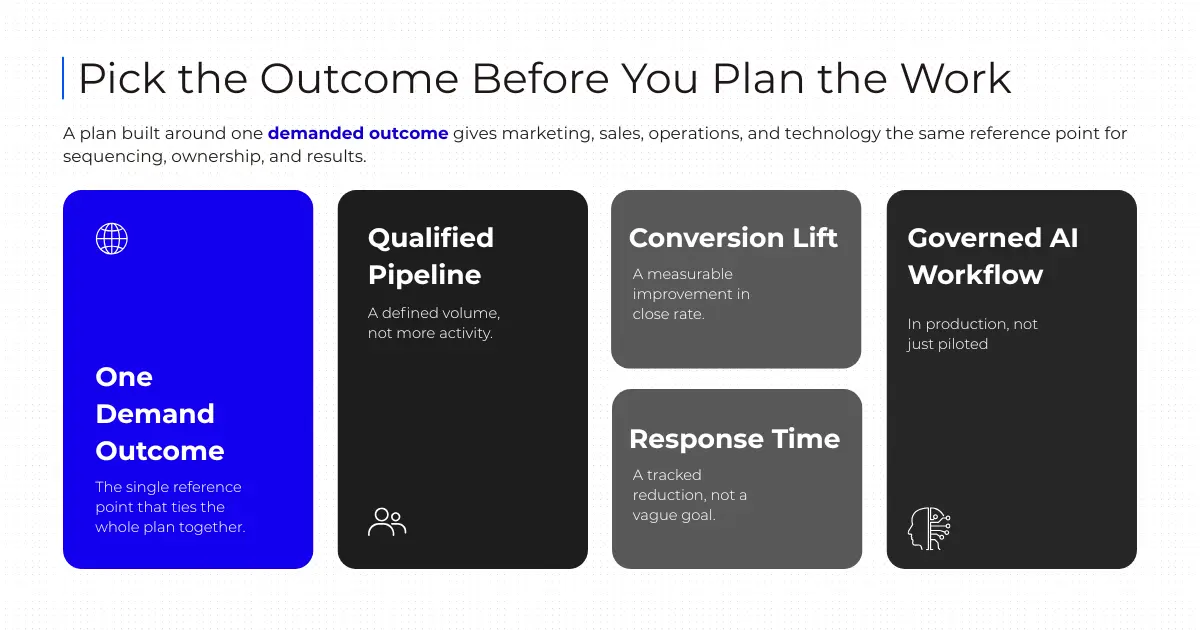
The plan should begin with the outcome leadership is demanding, not a list of projects. A demanded outcome is specific enough to guide tradeoffs. It may be a defined amount of qualified pipeline, a conversion improvement, a reduction in response time, a new website launch tied to tracked inquiries, a governed AI workflow placed into production, or a lower cost to complete a recurring process.
When the outcome is vague, every team can interpret the plan differently. Marketing may optimize attention, sales may optimize activity, operations may optimize efficiency, and technology may optimize implementation. Each function can report progress while the business outcome remains unchanged. A clear outcome creates one reference point for sequencing, ownership, measurement, and management review.
Translate the diagnosis into a constrained initiative set
A useful plan does not include every improvement opportunity found during diagnosis. It identifies the few initiatives most likely to remove the active constraint. If the market story is unclear, the first work may be positioning, proof, and page architecture. If qualified demand is being lost after inquiry, the first work may be CRM stages, response standards, sales assets, and follow up. If teams are overloaded by repetitive work, the first work may be SOP stabilization, workflow redesign, and controlled automation.
Each initiative should have a clear job in the system. Leadership should be able to explain what constraint it addresses, what dependency it requires, what business result it is expected to influence, and what would cause it to stop or change. This prevents the roadmap from becoming a collection of reasonable projects that compete for the same people and budget.
Sequence work by dependency, not enthusiasm
Growth initiatives often fail because they are launched in the order people are excited to build them. A new campaign begins before the website can convert. An AI agent is introduced before the process is documented. A CRM automation is configured before stages and exit criteria are agreed. A dashboard is built before data definitions are trusted. The result is rework and confusion presented as speed.
Dependency sequencing protects the investment. Clarify the market story before scaling content. Build proof before increasing traffic. Define stages and owners before automating handoffs. Stabilize the SOP before asking AI to execute it. Confirm measures before declaring a pilot successful. The plan should show these dependencies visibly so leadership understands why some work must happen before other work can create value.
Assign one accountable owner and the required collaborators
Shared ownership usually means unclear ownership. Every initiative needs one accountable leader who can make decisions, secure inputs, escalate friction, and report progress. That person may depend on marketing, sales, operations, finance, technology, or an outside partner, but the accountability cannot be distributed across a committee.
The plan should also identify collaborators and decision rights. Who supplies data. Who approves claims? Who validates customer language. Who controls CRM changes. Who reviews AI outputs. Who can accept a process exception. These details are not administrative. They determine whether work moves without repeated leadership intervention.
Use measures that show movement before the final result
Revenue is essential, but it is often a lagging measure. A 120-day plan needs leading indicators that show whether the system is improving. For a website and demand initiative, leading measures may include qualified page engagement, CTA progression, form completion quality, assisted conversion, and sales acceptance. For an integrated sales initiative, they may include response time, stage aging, next action compliance, conversion by stage, and outcome coding completeness.
For an AI workflow, measures should include cycle time, quality, exception rate, human review effort, cost, and downstream accuracy. The point is not to create a large scorecard. It is to select the smallest set of measures that reveal whether the intervention is changing behavior and performance. Every measure should have an owner, source, review cadence, and decision rule.
- Outcome measure: the business result leadership is demanding.
- Adoption measure: whether the new process, page, asset, or workflow is actually being used.
- Quality measure: whether output accuracy, buyer relevance, or handoff completeness improved.
- Speed measure: whether cycle time, response time, or decision time changed.
- Economic measure: whether cost, revenue contribution, margin, or labor exposure moved.
- Risk measure: whether exceptions, compliance concerns, or customer trust issues increased.
Build the management cadence into the plan
A plan without a management cadence becomes a static document. The operating rhythm should be defined before execution begins. Weekly reviews should focus on outcome progress, initiative status, blocked decisions, emerging risk, and the next required action. Monthly reviews should examine whether the original diagnosis still holds and whether evidence supports continuing, changing, or stopping an initiative.
The meeting should not become a task recital. Leaders should review variance between the demanded outcome and actual movement. They should identify the friction preventing progress, make decisions, update ownership, and capture learning in the process or SOP. This creates a continuous improvement loop rather than a temporary project push.
Use four decision gates across the 120-days
The first gate confirms the diagnosis and baseline. The second confirms that the design is complete enough to build. The third evaluates whether the pilot or initial release is creating the expected behavior. The fourth determines whether to scale, stabilize, revise, or stop. These gates prevent sunk cost from becoming the reason a weak initiative continues.
At the end of 120-days, leadership should have more than completed deliverables. It should have a clearer operating model, measurable evidence, stronger ownership, and a justified decision about the next cycle. That is the difference between a roadmap that manages activity and a growth path that improves the commercial system.
Why sequencing protects both speed and trust
The fastest path is rarely the path with the most simultaneous work. Parallel activity creates coordination cost, conflicting messages, and unclear accountability. Sequencing protects speed by resolving dependencies before downstream teams build on unstable inputs. It protects trust because customers and employees experience fewer reversals, incomplete launches, and promises that the operating model cannot yet support.
Leadership should communicate the sequence openly. Teams need to know what is being built now, what is being prepared, what is intentionally deferred, and what evidence will change the order. This reduces political pressure to treat every departmental request as urgent and keeps the 120-day path anchored to the demanded outcome.
The path must include customer and employee transition
Execution plans often describe what will be built but not how customers and employees will experience the transition. A website change may alter lead routing. A sales process change may change response expectations. An AI workflow may change approvals and role responsibilities. The 120-day plan should identify communication, training, customer continuity, and temporary fallback requirements so the business does not create avoidable disruption while improving the system.
Transition planning also creates a more realistic resource model. Teams need time to learn, test, correct, and adopt the new way of working. Leadership should distinguish build completion from operating adoption and should not declare an initiative complete until the people, systems, and measures are working together.
A 120-day path should end with the next decision
The final readout should not imply that the business reaches a permanent finish line on day 120. It should define the next decision based on evidence: scale the system, stabilize adoption, address a newly visible constraint, or stop an approach that did not create the expected movement. This keeps the plan connected to continuous improvement rather than a one time project mentality.
Frequently asked questions
Why use a 120-day growth plan?
The time frame is long enough to build and test meaningful capability while remaining short enough to force focus, ownership, and measurable decision gates.
How many initiatives should a 120-day plan include?
The number depends on complexity, but the plan should include only the initiatives required to remove the active constraint and support the demanded outcome.
What is the difference between a roadmap and a growth path?
A roadmap lists work. A growth path connects diagnosis, dependencies, owners, measures, decisions, and management cadence to a measurable business outcome.
What should happen after 120-days?
Leadership should decide whether to scale, stabilize, revise, or stop each initiative and use the learning to define the next operating cycle.
Turn the Diagnosis Into a Focused 120-Day Plan
Build a practical sequence that connects the priority, owners, dependencies, measures, and decisions required to create movement. Book a Growth Planning Conversation.